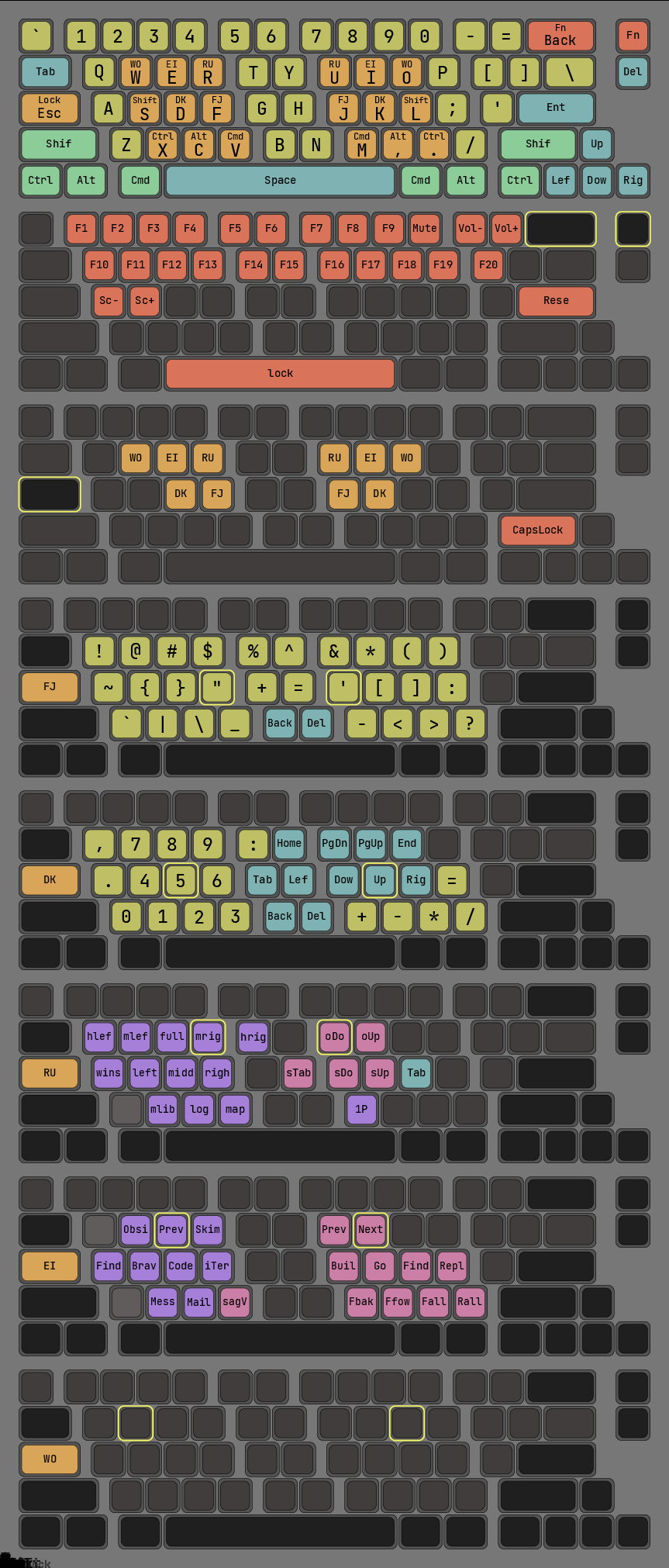
Sick! I've been building a little electronics project to render the ising model on an lcd screen, might have to do one for the potts model now too =D had never heard of it before.
I think zugzwang makes chess endgames richer - the fewer ways you can make a draw, the better, in my opinion. Maybe that's less appealing in go because games can go on for so much longer? At least in 19x19.
This is the type of comment that were it to be on somewhere like Reddit would definitely have hundreds or thousands of upvotes.
Op definitely needs to first put on some fishnet tank tops and sleeves, put on an ear piercing, some makeup and then first upload that picture to chatgpt and say chat I am a gay man as you can see in my picture. If I wanted to make gay ice how would I do that?
I don't think they are completely wrong - "=>" is just implication. A hidden assumption in their diagrams is that circles of different colours are assumed to be different elements.
A morphism from orange to yellow means "O <= Y". From this, antisymmetry (and the hidden assumption) implies that "Y not <= O".
Totality is just the other way around (all two distinct elements are comparable in one direction).
If this is meant to be an explainer, that can't be simply implicit. The text actually seems full of imprecise claims, such as:
"All diagrams that look something different than the said chain diagram represent partial orders"
"The different linear orders that make up the partial order are called chains"
The Birkhoff theorem statement, which is materially wrong. A finite distributive lattice is not isomorphic to "the inclusion order of its join-irreducible elements".
I don't buy it, I've used LLMs (well, mostly sonnet 4.5 and sometimes gpt5) in a variety of front-end frameworks (react, vue, htmx) and they do just fine. As usual, requires a lot of handholding and care to get good results, but I've found this is true for react codebases just as much as anything else.
> As usual, requires a lot of handholding and care to get good results, but I've found this is true for react codebases just as much as anything else.
I think you and others in this thread have either just skimmed the article or just read the headline. The point isn't that you can't use LLMs for other languages, its that the creators of these tools AREN'T using other languages for them. Yes, LLM's can write Angular. But if there's less data to train on, the results won't be as good. And because of this, it's creating a snowball effect.
Not your parent commenter but their point was clear to me.
To me, they don't buy the argument that the snowball effect is significant enough to overcome technical merits of different frontend frameworks.
And I'll add that: older libraries like React have at least one disavantage: there's a lot of outdated React code out there that AI is being trained on.
> I wonder if React has something to keep AI on their toes about best practices.
Ahh, I wouldn't hold my breath.
And to your point, I guess another thing Svelte has is it's compatibility with just vanilla JS, meaning (I think) it doesn't necessarily have to be "Svelte" code to still work with Svelte.
I don't buy the premise - that LLMs being trained on more React code than other frameworks is going to cause the collapse of alternatives. The data presented in the article isn't very convincing to me - it's absolute numbers, it's not a zero-sum game, and besides LLM coding is the worst it's ever going to be. Hypothetically, even if the data was convincing (showing a massively increasing relative share of React usage since LLMs entered the scene), I don't think it's sensible to extrapolate from current trends about LLM coding anyway. This stuff is barely a few years old and we want to make confident predictions about it?
> I don't buy the premise - that LLMs being trained on more React code than other frameworks is going to cause the collapse of alternatives
But if less people are exposed to those frameworks, then surely that means they will be less popular? I'm struggling to understand your argument.
> he data presented in the article isn't very convincing to me - it's absolute numbers, it's not a zero-sum game,
Of course it is. If I'm using React to build a site, I'm not using Svelte to build it. It less people are using a framework, there will be less funding. If more people use it, more money.
> I don't think it's sensible to extrapolate from current trends about LLM coding anyway.
The actual tools themselves are using React. Bolt, a UI design LLM, uses React by default. i don't even think there's an option to use a different language right now. These tools have taken over the industry, and have absolutely exploded in popularity in the few years they've been available. This is going to create a snowball effect.
> This stuff is barely a few years old and we want to make confident predictions about it?
I don't think you read the article as closely as you think you do. Saying "React has probably spiked in popularity because LLM's use it be default" isn't that controversial. And it's true. And I don't think it's a long shot to say "If there's less data associated with a framework, it'll be less likely to be used by these tools and then less likely to be used at all." In fact, it feels like a pretty obvious conclusion.
We can ignore what is clearly happening (which even as a React dev I don't want because it WILL limit my future options) or work to make sure those tools are offering other defaults.
> But if less people are exposed to those frameworks, then surely that means they will be less popular?
I agree, but I don't think the data suggests that is what's happening. The data presented in the article shows only that the number of new sites made with React has increased greatly since LLMs arrived on the scene. But there's a base rate fallacy here - we aren't shown data for any other frameworks!
>Of course it is.
That's not what I mean by a zero-sum game. There isn't a fixed number of websites that different frameworks are taking a share of (this would be a zero-sum game). The number of websites itself has massively increased since LLMs arrived on the scene. You can very quickly spin up 100 new sites using your new framework without all the other frameworks "losing" 100 sites, you know what I mean? Similarly I think the number of people making websites has exploded for the same reason.
And this is another explanation for the data in the article - that there are simply way more sites being created now that it's so trivial for anyone to make one. Have a look at the StackExchange links I gave in my last comment. There isn't much evidence there that React is overwhelming the industry (especially amongst professional devs), although I grant you it would be difficult to measure if it were true.
> The actual tools themselves are using React. [...] These tools have taken over the industry.
Yes, but so have plenty of other tools that don't use React by default, like Claude Code or Codex. There are plenty of new websites being made across all of the major frameworks.
> I don't think you read the article as closely as you think you do.
Do you mind cutting it out with the ad-hominems? I've been nothing but respectful to you, and in each of your replies you've made little jabs at me about "not understanding the article". I just disagree with you, friend, be nice =)
Why is this on the front page of hacker news? Hopefully that comes across as a genuine question and not snark. I mean as an ex-mathematician I'm thrilled, but schemes are an incredibly abstract object used in an incredibly abstract branch of mathematics (algebraic geometry).
Interesting, yeah. I guess he was the mathematical equivalent of the "rogue" archetype. Brilliant, did things in his own way, total lack of respect for authority, shrouded in mystery. I can definitely see the appeal =)
in many educational systems, aptitude in math (the more abstract, the better) is conflated with intelligence. so maybe many of us have internalized we should valorize it?
Sometimes, the best way to learn about abstruse topics one has a passing curiosity in is to upvote what pops up on HN and hope that some nerd might drop by and comment with a simplified intuitive picture for plebs :-)
These days, some nerds prefer to ask AI to confirm their "precious" intuitions of why schemes might be needed in the first place. To fix the problems with certain basic geometric notions of old timers? They are then so spooked that the AI instantly validates those intuitions without any relevant citations whatsoever that they decide not to comment
But still leave warnings to gung-ho nerds in the form of low-code exercises
That's a theory, but I think it's more likely that the few people in the world who deeply understand schemes are locked in the basement of a mathematics department somewhere, and not on hacker news =P
>
That's a theory, but I think it's more likely that the few people in the world who deeply understand schemes are locked in the basement of a mathematics department somewhere, and not on hacker news =P
I rather think that because of the very low career prospects in research, quite a lot of people who are good in this area rather left research and took some job in finance or at some Silicon Valley company, and thus might actually at least sometimes have a look at what happens on Hacker News. :-)
I think you overestimate how many people exist in the world with a professional interest in algebraic geometry! The vast majority of mathematicians have no idea how to compute with schemes (and there aren't that many of them to begin with).
Even though I am from in a different area of mathematics, I know quite many people who work(ed) in algebraic geometry (and at the university where I graduated there wasn't even an academic chair for (Grothendieck-style) algebraic geometry).
The amount of people I know who would love to learn this material is even many, many magnitudes larger (just to give some arbitrary example: some pretty smart person who studied physics, but (for some reasons) neither had any career prospects in research nor found any fullfilling job, who just out of boredom decided that he would love to get deeply into Grothendieck-style algebraic geometry).
I guess we hang out in different academic circles. I met a single algebraic geometer in my whole academic career. But people are into very different stuff where I come from, which may have biased me (topology, number theory and category theory for the most part, and a lot of relativity/fluid dynamics on the applied side of the department). Based on rough estimates from papers published on arxiv over the last few years, I (very) conservatively estimate there are ~5000 working algebraic geometers in the world right now.
> The amount of people I know who would love to learn this material [...]
I am one of them =) but my point wasn't really about people who want to learn the material (which I assume includes many orders of magnitude more humans) it was about people who already deeply understand it.
It's hard to help GP but I'm gonna try (pls forgive me):
I believe that the masses don't have a deep understanding of Schemes because of enemy action by the sufficiently advanced stupidity (aka loneliness) of the intelligent :)
Their interest is "pro" and they are not a hypothesis
(& I'd NOT bet against that they understand deeper than Sturmfels and his students)
Schemes (like cat theory) have become a sort of religion-- it's sad because Grothendieck himself might not have understood them intuitively.. and it won't be the first time.. Feynman didn't understand Path Integrals, nor Archimedes integration!! BECAUSE they were all loners whose first resort was WRITING LETTERS
Ps: as with Jobs.. I hesitate to call Buzzard a full-time salesman
If you want to hang out in meatspace: do you have a public key?
This is very cool as a science experiment, but if you're interested in getting the best results (for you) you should just taste as you cook. We're born with high-fidelity chemical and tactile sensors - use them!
Can you provide examples of software that should have literally been a spreadsheet or an ETL? Not to call you out specifically but this feels like "I could have written that in a weekend". Personally whenever I have felt that way about a project it turned out I was just missing 95% of the business context/domain knowledge (part of the reason I think rewrites are a bad idea - chesterton's fence).
I can give you one - a billing system with reporting features that suck dreadfully compared to what can be done with a spreadsheet. Why not "just" let the user download a CSV and then do whatever they want with it?
I was working on this project and I kept suggesting it. It was seen as inferior and yet the system we were going to produce was far inferior in every way.