Isn't this just solved by better student teacher ratios, which you could totally have in public schools if they were funded better and societally we valued teachers more?
What are private schools doing that you couldn't implement in public schools with adequate political will and money?
Your question is easily resolved by looking up how much American schools are funded, compared to historical funding, other countries' funding, and their relative successes.
Outcomes aren't any better with lower ratios. The best-funded public schools have funding higher than anywhere else, in the world, and have poor outcomes... it's not a funding problem. And it's difficult to "value teachers" when we learn of these outcomes, it runs counter to human nature.
Private schools are (excepting the truly 0.01% which are the most elite schools meant for the children of billionaires and statesmen) are nothing more than public schools dressed up in $20,000/yr tuition so that the upper middle class can feel special. They draw personnel from the same pool of teachers, they use the same textbooks and pedagogy. They are essentially public schools with a new label. But that you think I might be talking about private schools shows how you can't even really think about alternatives. You don't have the mental language to do so.
> I felt frustrated that the professors didn't ever teach. They had slides. They read off slides, verbatim. They explained things sometimes if you asked them, but most often in a very elitist and condescending tone
+10000. The goddamn slides. If I were a student now going to engineering school, I'd basically take the slides and throw them into NotebookLM and get way better lectures. Then I'd ask claude or GPT all my hard questions. Hell, I'd get the PDF version of my textbooks and do the same.
The number of lectures actually worthy of your time was so low.
I try to lecture as little as possible. No slides. Quick highlights discussion of the reading, maybe a coding demo, and then students work on coding challenges in class, in groups if they want. I circulate and help out. I'm lucky to have small class sizes at this university. I couldn't pull it off in a class of 300.
Have you found Gemma 4 31B better than Qwen 3.6 27B Q8? I just started using Qwen + Pi agent and it's great, but "which model works best" is still totally crowdsourced and I was going off of peoples' opinions on reddit. Would love to hear more opinions if people have them.
> Have you found Gemma 4 31B better than Qwen 3.6 27B Q8?
Which quant of Gemma? For coding Qwen seems to be pretty far ahead, but generally Gemma seems to have a "vaster" set of knowledge, but armed with a search tool it doesn't really matter, and Qwen 3.6 been really great for all sorts of tool calling. I mostly do programming and related things though, fwiw.
> I was going off of peoples' opinions on reddit
It's extremely astroturfed all over the place, especially the larger subreddits, and especially the one related to a specific animal in a specific location. It's sad, as early on it was a great resource, but now it's mostly paid posts and a race to the bottom, with lots of piling, and all the knowledgeable people I used to recognize are nowhere to be found.
Just a bit of flair. Also, bunch of people have "keyword watchers" setup for various terms, so when you mention certain things on HN, reddit and elsewhere, you get commentators who enter the conversation not because the context or larger conversation, but because the single term/thing they care deeply about was mentioned, and it just gets very boring to read the whole attackers/defenders comments over and over again. But ultimately I just did it like that because it was more fun to write it like that.
I'm not sure that GP is correct, many people in that forum tend to hate Qwen for closing up many of their more recent models and leaving the whole local inference community 'stranded' on their older releases.
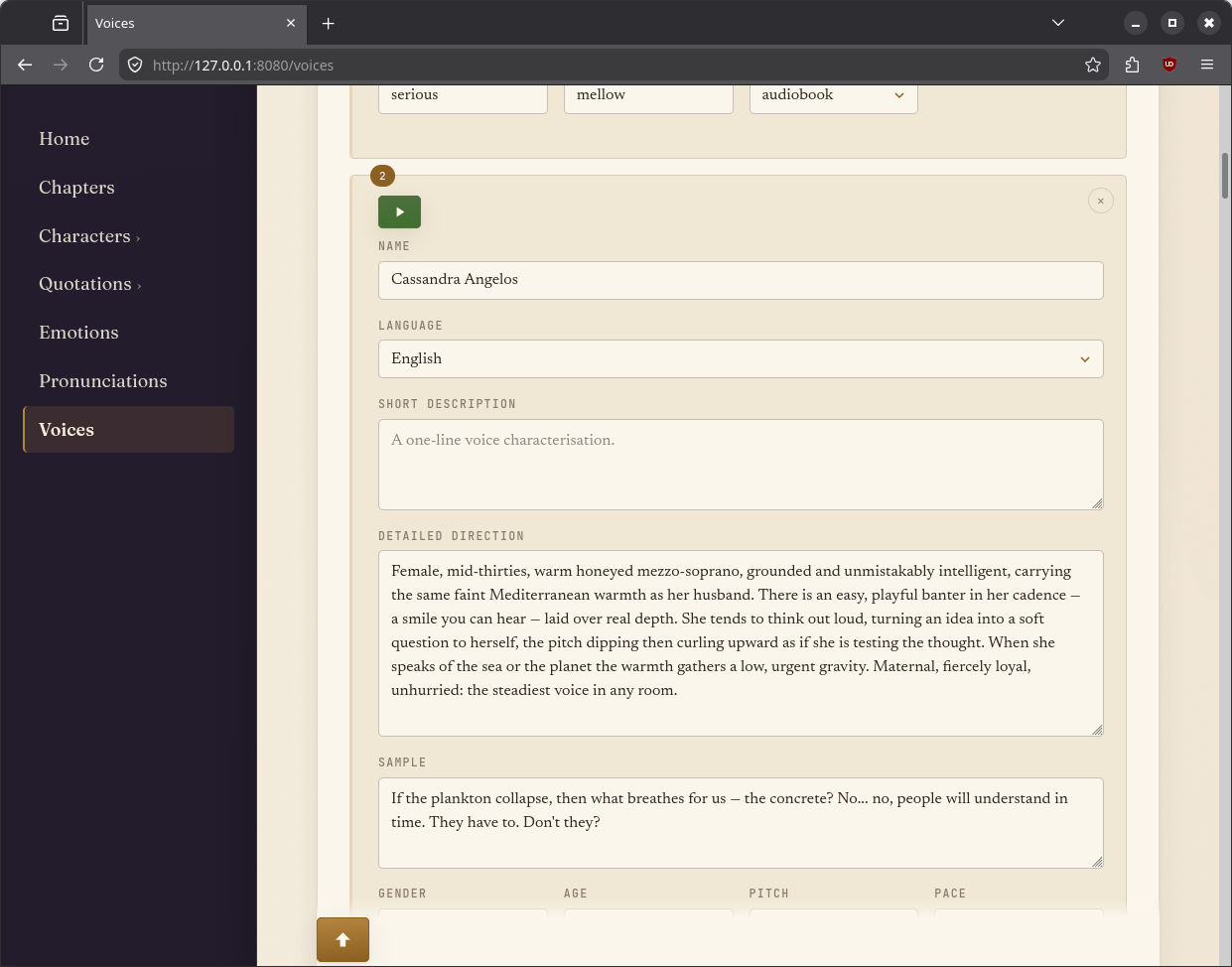
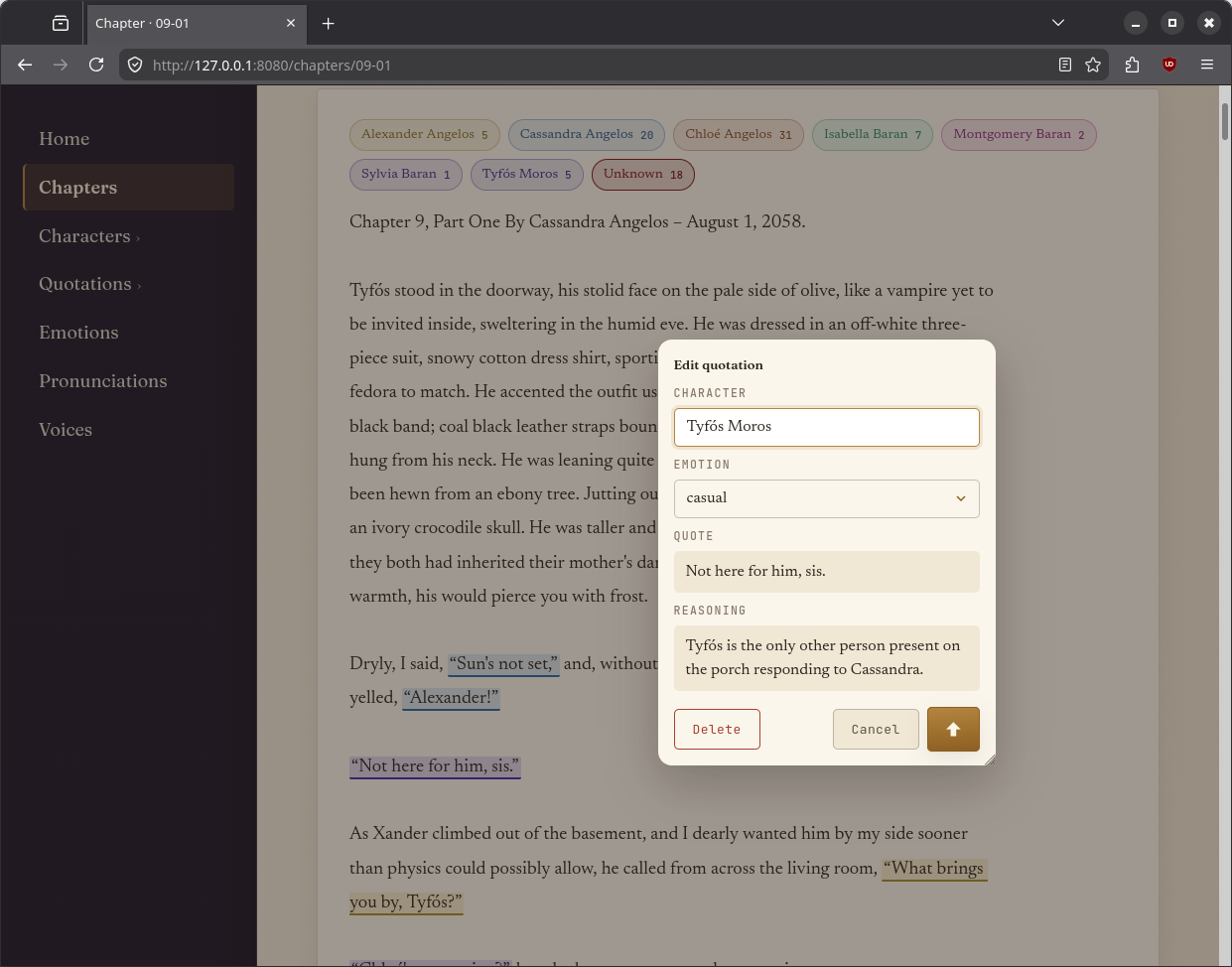
Yes. I'm using Gemma-4 31B (gemma-4-31B-it-assistant.Q4_K_M.gguf) with llama.cpp to attribute quotations throughout chapters of my sci-fi novel. I started with Qwen3, but couldn't get it to work. Qwen3 TTS Voice Design, on the other hand, is incredible (Qwen3-TTS-12Hz-1.7B-VoiceDesign). I'm using both for an audiobook generator that produces a variety of voices.
Gemma 4 31B is enormously impressive. You get 1000 requests/day for free on Google's API and another 1000/day off OpenRouter. Only problem is you get 503 like crazy.
+10000 that Azure is a steaming pile of shit. Like what's this -- `azcopy` broken at head, and the working one doesn't guarantee correctness after a copy (99.6% copied successfully! good luck figuring out what went wrong!) compare that to migrating data with GCS or S3 -- they provide first class tools that do it right quickly (aws-cli, gsutil).
Want a VM? You'll also need this network security group, network interface, network manager, ip, virtual network... and maybe it'll be connected to the internet so you can SSH in? Compare to GCP or EC2 -- you just pick an instance and start it. You can SSH in directly, or even do it in the browser.
Billing also a nightmare: if you're running a startup, AWS and Google make it relatively easy to see how many credits you have left. The Azure dashboard makes you navigate a maze, and the button to click that says "Azure Credits" is _invisible_ for 30s until ostensibly some backend system finds your credits, then it magically shows up. Most people don't wait around and just assume there's no button.
And if you click it, maybe you will happen to be in the correct billing profile, maybe not! Don't get confused: billing profile and billing scope are different concepts too! And in your invoice, costs just magically get deducted, until they don't. No mention of any credits. Credits inaccessible through API (claude tried everything).
VMs, bucket storage, and copying data are the _simplest_ parts of the stack. Why would anyone bother trying to use other services if they can't get these right?
They literally give startups 2x the credits as GCP, 20x the credits of AWS and nobody wants to use them.
Azcopy is special bad, the team that looks after it is made up entirely of junior developers that obstinately refuse to listen to feedback.
Its documentation title is "Copy or move data to Azure Storage by using AzCopy v10" but it can’t actually do trivial operations like “move” because the devs are too scared to write code that deletes files: https://github.com/Azure/azure-storage-azcopy/issues/1650#is...
I recommend switching to “rclone” instead to avoid the frustration. It won't fill your entire system disk up with unnecessary log files unlike azcopy, which is a significant source of production server outages where I work because of this default behaviour.
It has utility though: unlike the dollars in your mattress, it can't be printed into oblivion by your central bank. It is relatively portable, and people have flocked to it as a store of value especially during periods of socioeconomic instability when assets are going down and gov't spending is going up. It's tradeable for fiat in any country, so it allows you to bring value along if you relocate.
Its price reflects that utility and like any modern asset, a lot of speculation. You can speculate on whether it's more or less useful given current events -- nothing wrong with speculating that it is only going to be increasingly useful.
Agree it doesn't generate wealth. It's explicitly a store of wealth.
Investment is a weird term because most people would consider keeping cash or cash equivalents (gold) to be investments, even if they don't generate wealth. Cash is also an opinion, in terms of the market.
During the prompt embedding optimization, the embeddings are allowed to take on any vector in embedding space, instead one could use a continuous penalty for superposing tokens:
Consider one of the embedding vectors in the input tensor: nothing guarantees its exactly on, or close to a specific token. Hence the probabilities with respect to each token form a distribution, ideally that distribution should be one-hot (lowest entropy) and worst case all equal probability (highest entropy), so just add a loss term penalizing the entropy on the quasitokens, to promote them to take on actual token values.
I'm similarly puzzled by "uncured bacon" which afaik still uses naturally occurring nitrites. How they're allowed to call it uncured when it's clearly still cured is beyond me.
A lot of people use them together (cursor for IDE and claude code in the terminal inside the IDE).
In terms of performance, their agents differ. The base model their agents use are the same, but for example how they look at your codebase or decide to farm tasks out to lesser models, and how they connect to tools all differ.


What are private schools doing that you couldn't implement in public schools with adequate political will and money?
reply