How about two vertical monitors? I use a laptop and normally also have connected two 27″ monitors, both vertically oriented, above it. There are certain code tasks that really benefit from the increased height of vertical orientation; as an example, last week I was doing some substantial rebasing, and the increased vertical height in a four-way diff was invaluable. Most of the time I find I’m actually using at most one of the external displays, but it’s definitely still common to get practical value out of both of them. Referring to web pages or other documents on vertical screens is also normally better—mostly normally because they’re half the DPI of my laptop display.
(The slight off-centring of the laptop in this diagram is also curiously realistic; early on, a couple of years ago, I had it centred; but a few weeks ago I looked closely at where it had ended up, and found that I consistently placed the laptop definitely right of centre, and favour the right-hand monitor to the left.)
A few others in the company use one or more vertical screens too. Those of us who do, certainly like the increased vertical space.
Quality of window management is also going to be an important factor: of the two main OSes: Windows is good at simple window-per-screen and two-tiled-windows-per-screen arrangements; macOS is fairly weak, being more inclined to manually accomplishing it. (I’m on Windows for now, but I’m planning on trying Arch Linux, which I previously used, on my Surface Book, as it’s now probably good enough to work with. With Sway (i3 clone for Wayland), its handling of such a screen arrangement will be superb.)
So I’ve tried vertical monitors and I find them to be very unergonomic. Your head naturally moves from the top of the monitor to the bottom. What I find this results in is too much head movement and half the time your neck is tilted more than it should be (ie more than is ergonomically safe).
It’s phenomenal for reading threads and large pages but I’m not sure it’s good for you.
This is specially the case when you are bound to use glasses. Just moving the eyeballs up is not enough, you have to move the head a lot. I use three horizontal 24' monitors and find it almost ideal. I could use one more stacked vertically where I place some windows which I glance at less often than a minute or so, like a grid of tmux panes containing logs.
Perhaps the problem you've experienced is with the 16:9 monitors that were forced on everyone a ~half decade back. Or rather 9:16 in this orientation. I still (barely) prefer them vertical, but it is true they are not optimal either.
I much preferred my portrait 4:3 1600x1200 (as 3:4) monitor a decade ago. Was close to perfect since there was room for two long windows side by side.
I've wondered if 16:10 might be good also. But as mentioned, those choices were eliminated in the "great widescreening" of the 2010s.
I have a Surface Studio as my main work monitor and two vertical 16:9 monitors I keep terminals and documents on. It's great for editing code and having windows side by side. I think we may seem a little bit of a resurgence of the 3:2 aspect ratio, but that maybe be wishful thinking.
I'd like a citation here. Keeping your headed tilted at an odd angle for months is ergonomically unsafe. Head motions? I've never seen studies that motion was unsafe, so long as the neutral position was neutral. Indeed, all I've seen suggests you want to move and stretch more.
The whole presumption that you want to spend 8 hours in an ergonomically ideal position without motion seems like bunk. Indeed, I find changing positions to be much more ergonomically valuable than having an ideal position. If I spend 30 minutes each across 16 awkward positions, I do just fine. An ergonomic chair, mechanical keyboard, perfect-height monitor, etc. for an 8 hour stretch each day hits me much harder.
> The whole presumption that you want to spend 8 hours in an ergonomically ideal position without motion seems like bunk.
That’s because it is bunk. Low back pain researchers found ages ago that the most ergonomic setup for alleviating back pain was the one that let you shift positions every 15 minutes or so. There is no position so ergonomic that the body can tolerate holding it for extended periods of time.
That's actually a perfectly legitimate thing to ask for. Our feelings and subjective experiences are very real, but our recall of them is terrible. Properly tracked, they're useful data, and such tracking could be cited here. Summoned up from memory, they're noise.
Parent never described how it made them feel -- they described the motions they made, and called that not ergonomically safe. If op has said "I got a kink in my neck," it'd be a different story.
I have a setup similar to GP’s except with a horizontal monitor between the two vertical monitors. The part of my desk holding the monitors is physically separate from the part my keyboard rests on so I can sit as close or as far away as I like. I tend to sit father back than I do with my gaming rig which is a single curved ultra wide. Probably better on my eyes. Most of my work is on the horizontal screen. Vertical screens are typically used for referencing information or if I use them heavily for other purposes I tend to have windows at the same level of as the horizontal screen.
So I’ve tried vertical monitors and I find them to be very unergonomic. Your head naturally moves from the top of the monitor to the bottom. What I find this results in is too much head movement and half the time your neck is tilted more than it should be (ie more than is ergonomically safe)
Each year my company's HR department brings in ergonomics experts who watch each employee work, and they make suggestions (This employee needs a new chair... this employee's keyboard is at the wrong angle... this employee sits too low and his feet aren't on the floor right... etc...)
The last time they came through, they voiced no objections to my portrait monitors.
Two portrait, one landscape (actually all the same size, which i couldn't be bothered to do in the diagram, sorry); one window maximised on the landscape, and each portrait tiled with two windows.
It's usually the IDE or a spreadsheet in the middle, email or Slack bottom left, market data top left, monitoring/CI top right, and terminals bottom right. Quite often i split the middle landscape monitor too, with an editor in the left half and docs in the right half, or editor left and gnuplot right.
To be honest, the density value is low; this is definitely a case of screen sprawl. Having my email always up does not help productivity, having Slack always up is even worse, i rarely look at the market data (at the moment), and CI and monitoring could be a panel icon and some notifications rather than half a screen.
But then, i find looking at the upper half of the portrait screens a bit uncomfortable, so it makes some sense to use them for information that i don't look at all the time, but is really handy to have occasional fast access to.
Some of us will change our entire lifestyle just to find reasons to donate screen space to live data streams for no reason other than that it looks cool and satisfies our deep-seated nerd fantasies.
What is the point of a 4-way diff? I never used a rebase workflow and I always merge. When merging you compare the common ancestor with the two different branches, and it’s the perfect use case for a three monitors setup with the three-way diff. From what I understand rebasing is pretty much the same but it rewrites history to have a single branch. Why you would need a 4-way diff in a rebase instead of a 3-way diff?
If you want to see what changed between two versions you are merging (both without your changes), your currently in progress merge, and your current version before you started merging.
I have 3x 39" 4K TV's as my monitors. As Shown in the above, I use them as the equivlant of 6x ultra-talls.
I use windows. If you do, you can choose this layout quickly: hit Win+<Arrow Key> to adjust the layout of your current window and/or move them from screen to screen.
Honestly I'm a bit surprised people don't do this more. (I do coding all day long) You can get the TV's for about USD$300 each. 3x is a bit overboard I admit, but 2x is really, really awesome and it's distressing trying to code on my laptop anymore.
Most TVs have some weird effect where it just puts white dots in the middle of the strokes of a charater glyph.
However, I've seen several Samsung TVs which doesn't suffer from this phenomena and can be used as proper monitors.
For coding purposes I don't think color accuracy matters much, but I see why latency might annoy some people, though it doesn't bother me.
Please pardon my comment with limited background knowledge but are you sure that TVs, with their hardware designed to make you look from far are a good idea to keep close to your eyes?
I have 1x 43" 4K monitor (Dell P4317Q), and together with a tiling WM it's pretty awesome as you say. It's more expensive (I think $800), not sure if it's sufficiently better as to be worth it.
I have the same (single) monitor and love it. $699 at MicroCenter.
I like to sum up this debate like this:
With multiple monitors, you're confined into smaller, "hard-coded" boxes that can't be changed. With a single large screen you have much more flexibility.
You need extra functions in your window manager for moving between screens with multiple monitors. Depending on their placement the shortcuts might be non-intuitive. Different screen resolutions lead to unnatural movement of the mouse cursor between screens.
I've also found that such extra complexity impacts productivity negatively. It's an unnecessary distraction trying to communicate such complicated layouts.
I'm just using a 27" 5K iMac, BUT sometimes I change its resolution from the default, virtually 2560x1440 one to the highest DPI, which I guess is the native 5120x2880 and I just pull it closer and/or lean closer to it.
I think for programming the 2560/1600 = 1920/1200 = 1.6 or the 3000/2000 = 1.5 ratio is a reasonable middle ground. Unfortunately it's not a common ratio among big but cheap monitors...
The extra head movement required to look into the corners of a 27" or even a 25" vertical monitor definitely puts a little strain on my neck compared to a 25" horizontal one, but with frequent posture changes and breaks, while a bit tiring, I don't feel it caused any permanent damage.
At least I hope it's not the reason why the middle of my upper back feels like falling apart any minute... Maybe that thai massage, when a lady was walking on my back for half an hour was a bit too much? :D
Yes! I have the same and despite spending thousands of dollars trying to find a better monitor it's still best solution I've found. I can keep 4x80 column files open in vscode or 8 if I split them vertically. And with a single monitor I can still easily use a KVM switch.
How far away are they? That's a lot of physical space to cover.
I use a single 40" 4K monitor (not a TV but only by lack of a tuner) and that's about 30" from my face most of the time. That's too big. I often neglect vertical space because it involves moving my neck.
But three of these things is over 8 foot of vertical space. That's ridiculous.
they sit about 2' to 3' from me, just like a normal monitor.
it's only about 2' of vertical space, but 8' of horizontal, so I have them laid out in a semi-circle.
I have 39" seiki TV's, all about 4 years old now. As one of the other posters mentioned, it actually seems rare to find any 4K TV that small any more. But a brief search on amazon shows you can still get stuff in that price range, but Seiki seems to be gone :(
At three foot, you have a circumference of 18foot. The idea of almost 180° of monitors still unsettles me. That's beyond neck work, that's practically into separate workspaces. If you're looking at the left side of Monitor 1, Monitor 3 is physically out of —even peripheral— eyeline.
I don't know why I'm flapping on about it. If it works for you, that's great.
you are right that 3 monitors is excessive. I find myself only really using 2 of them.
Using the 3rd requires me to twist my upper body a bit uncomfortably. as a result I find that I tend to keep it dedicated to little used apps, like email and sourcetree (a git gui)
macOS has terrible native window management, but there are a number of window manager programs that are as good as what's available on Linux. BetterTouchTool is my favorite.
Magnet (http://magnet.crowdcafe.com/) costs 1 USD, but it provides mouse control via snapping at the display edges and it's also tiny (6MB).
Its default keybindings does NOT clash with most apps. They are logical, hence memorable. They are easy to press too.
In fact I invented the same shortcuts and I was always changing the Spectacle defaults to them on every installation, which was tedious... With Magnet I don't have to fiddle at all.
I used xmonad on NixOS and I quite like it, but in any tiling wm on macOS I tried, I hit some issues within 5-10 minutes.
I've become quite fond of Amethyst (https://github.com/ianyh/Amethyst). Especially it's 3Column Middle Wide layout in combination with swapping windows using the mouse and mouse pointer being placed in the middle of a switched-to window have been godsents for my daily workflows.
Triple for me. Have an Ergotech stand with the extra wide arm. In the middle sits a 21:9 34" 3440x1440, then on each side floating in the air a 16:10 24" 1920x1200.
Love it. Have my focus app in the middle, e.g. Code or Visual Studio. One side screen can have e.g. Sublime Merge, and the other a browser for testing, or a few terminals.
TL;DR : if you want to mount monitors vertically side-by-side, try before you buy.
One thing to watch out for if you install two vertical side by side monitors is that many monitors (especially gaming monitors) are optimized to be watched horizontally.
That sounds weird, so let me explain:
LCD's have a sort of a "field of view": if your watch them straight (at 90 degrees), the amount of light reaching your eyes is maximum. If you look at them sideways (eg 45 degrees), the amount of light that reaches your eyes decreases (this typically happens when you look at a co-worker screen while sitting next to them).
Good LCD's have a wide field of view: you can look at them from the side and still see a good image.
But the expectation is that you will watch them from the side, not from above or below, and manufacturers have taken advantage of that fact: they optimize for a wide horizontal field of view, but the vertical field of view is, on some monitors, terrible.
It does not matter unless you mount the monitors vertically, in which case the vertical FOV becomes your horizontal FOV, and you might not even see the image on the outer edges of the monitors.
> macOS is fairly weak, being more inclined to manually accomplishing it.
I found the SwitchResX app [1] to be really useful for switching to portrait mode on macOS. I have a 2017 13" MacBook Pro and that app made it possible to use the 27" LG UltraFine 5K display in portrait mode. I also use Spectacle [2] for moving windows around with the keyboard.
I tried this before and my neck was sore for a week. It was really really painful. I’ve basicslly given up on dual monitors in general, give me one 27” 5K (iMac) monitor and I’m happy.
I found that the most problems are for the eyes, if the monitors take too much of your FOV. I worked in the past with 8 monitors and after a while it really impairs my ability to focus far away. Luckily it seems reversible after several months, especially if you spend a lot of time outside looking far away.
You can place monitors at different distances from your eyes. Screen resolution can be changed to maintain perceived relative size of onscreen objects.
For eye health, have the monitors backing a window (or 20+ feet of empty space), so that you can periodically (at least every 20 minutes) look past the monitors at an "infinite" plane.
It’s not practical in an open office with everything standardised. Sure in an Home Office you can do pretty much what you want if you have enough space.
You can at least position the laptop closer than the monitor, which gives you two focal planes. In an open office, there should be many "distant" objects to use as a temporary third focal plane.
I brought my own clamp-on monitor arms to the open office I work in and installed them myself without asking anyone. You might be able to get away with the same.
I recently switched to a landscape 28" 3K monitor as my main monitor, with a portrait 24" monitor as secondary - I've found this arrangement suits me really well. I typically have a console window open in the lower half of the portrait monitor, then something else in the top half depending on what I'm doing (maybe unit tests window, or a DB admin tool, whatever)
Yeah, and that's even the hero image of this article with no mention. I find having a secondary monitor in portrait is great. Laptop is primary, but the portrait is great for reading. Also, for debugging for mobile.
That will depend a little on the window management techniques employed. For me, it works very well, and I would actually consider a seamless blend of the two displays to be a slight regression, given Windows’ automatic snap behaviour or i3-like layout.
But I’m with you on the resolution matter. My external displays are nowhere near as pleasant to read from and use as my internal display—yet it was I that chose the two rather than one 5K or similar display. Bear in mind too, especially when dealing with laptops, that that not all hardware will be capable of driving multiple high-DPI displays. If I recall correctly, two 4K displays is supported by the Surface Book + Surface Dock, but only at 30fps. (I have the vague, unfounded impression that most laptops wouldn’t support it at all.)
I used to have 2 monitors side by side turned vertically. The problem for me was that the rotation was down in software in the video driver and many redraws were noticeably slower. It was long ago though (2007 ish), maybe modern performance makes it unnoticeable.
The other issue I've noticed is the (polarizing?) filter built into monitors seems to be oriented for landscape viewing only. So when you have screens in portrait, there's no perfect viewing angle that lets you see all the way left to right on the screen surface, without the filter obscuring one of the sides.
If you’re on windows, display fusion is a top notch window manager, it gives a single button to span wide across all screens for time when you want on window to rule them all.
Recently switched from spectacle to amethyst. So far I'm happy. Every now and then it bugs out and you need to restart it, but in general I spend less time adjusting window positions.
It really only makes sense on large screens though. If you spend a lot of time on the laptop screen overlapping windows + spectacle is better.
I am a minority opinion here. I don’t like turning my head and I like just having everything I need for a 2 hour sprint visible at once on the screen.
At home I use a MacBook with a 22” retina I bought at the Apple store, the external monitor place directly above the laptop. I rarely do video or photo editing, but I spend a lot of time writing books and also programming. This is plenty of space for me. This is not a matter of money: 6 months after I bought this monitor for my home use, I started working at a large financial services company; I could choose any monitor(s) I wanted and I chose exactly what I have at home.
I don’t multi-task, especially in my home office. I like having just what I need for my current task visible.
I bought a System76 Oryx Pro last fall with a 16” 4K display and I find the screen size so adequate to my development needs (I use that laptop just for machine learning, it has a 1070 GPU) that I don’t even bother hooking it up to an external monitor.
I have spent so many years working on remote servers in a few SSH shell windows. This might affect the setup I chose for all-local development and writing.
There is little benefit in multiple monitors for Office work (Excel, word, etc).
Server admins have some benefits for multimonitors.. i.e keeping documentation open while you're on the server etc.
Especially if the Excel rows arent too wide
GUI development gets massive value from multiple monitors. Nothing beats having the application open and visible while you're changing the code.
It gets even more important if you're a full stack developer, which has several terminals open to keep track of logs, a browser for the webpage you're modifying and the editor for changes.
You definitely raise some valid use cases where you need more real estate, but I think a big reason people on Mac/Windows feel like they need more space is because window management is so poor on those platforms. I came from Linux where I used tiling window managers and I really missed that on Mac. I ended up installing Amethyst and while it's not nearly as powerful as the window managers I was using before, it almost entirely killed my desire for my real estate. Now I can quickly and evenly split my editor, terminal, and browser into various layouts and adjust them as needed.
Office/office work can absolutely benefit from multiple monitors or large monitors. For instance, having spreadsheets open for reference, at the same time as a document you're writing.
I'm most productive on a single (big) 4k screen. I normally run at 125% scaling and it's perfect for my work (desktop application developer). My main Windows desktop is where I work (usually Visual Studio or PyCharm plus a browser) then I have a second virtual desktop where I have stuff that I need throughout the day, but use infrequently (music player, email, slack, skype). I have keyboard shortcuts to jump to any of my frequently used applications.
I'm easily distracted so I want to keep as few windows in view as possible.
I keep a book and a guitar near my desk and rather than jump to Reddit or HN when I'm rebuilding, I'll read a few pages, play some scales, or go make some tea.
+1 for keeping a book and guitar handy! I keep my guitar packed away but do keep an American Indian flute and a didgeridoo handy. I think music, played briefly while waiting for a machine learning experiment, large Haskell project build, etc. is much better than web browsing because it does not ruin focus.
+1 for playing some music as a form of break.
When I was younger I often practiced simple songs on a tin-whistle, recorder, kaval or flute. I liked the saxophone the most but that requires too much maintenance, hence it's a distraction.
Agreed. Another reason I prefer this setup is because I don't like using an external mouse or trackpad with my Macbook Pro. I use the swipe options extensively to switch workspaces and I like having my hands close to my typing position at all times.
> I use the swipe options extensively to switch workspaces
The mouse that I have lets me remap the buttons, so I have two of them mapped to "switch left" (like a three-finger swipe) and "switch right." I find that that is pretty nice for me.
Same here, that's why I have one of my desktop monitors (~22") above the other. At work, I used a similar setup with my ThinkPad in a docking station as the lower screen, but then again you get the small screen penalty ;-)
Notably missing from this study is any note of the display resolution. The market is flooded with a glut of 22-26" monitors that have the same low resolution as the smaller ones they are supposedly designed to replace.
This is all also really dependent on the applications you run. I'm personally stuck running a CRM and remote control programs that open new windows for everything. 1 large high-resolution display + heavy use of macOS workspace seems like the best way to deal with it, though my colleagues all prefer 2 displays. Anecdotal observation indicates that none of us can easily find the window we were just looking at once we move away from it, so I think the window manager needs work too.
>> The market is flooded with a glut of 22-26" monitors that have the same low resolution as the smaller ones
The 27/30" inch monitors that are only 1080 make no sense to me. Maybe if you have really bad vision. I love my LG 4K and would like a 27" 5K but they're expensive. The text is so sharp on those things.
But, for a 21" monitor that is only 1080, if you're using multiple ones, you can sit back far enough away to be able to see 4 of them and not have the text unreadably small.
The younger guys at work like 25" 2560x1440 monitors and just run 8 point fonts, my vision was never very good so I could never use that for more than a few minutes. I'm using a pair of 27" monitors but I do end up turning my head a lot. I'd like to try a 3840x1440 screen.
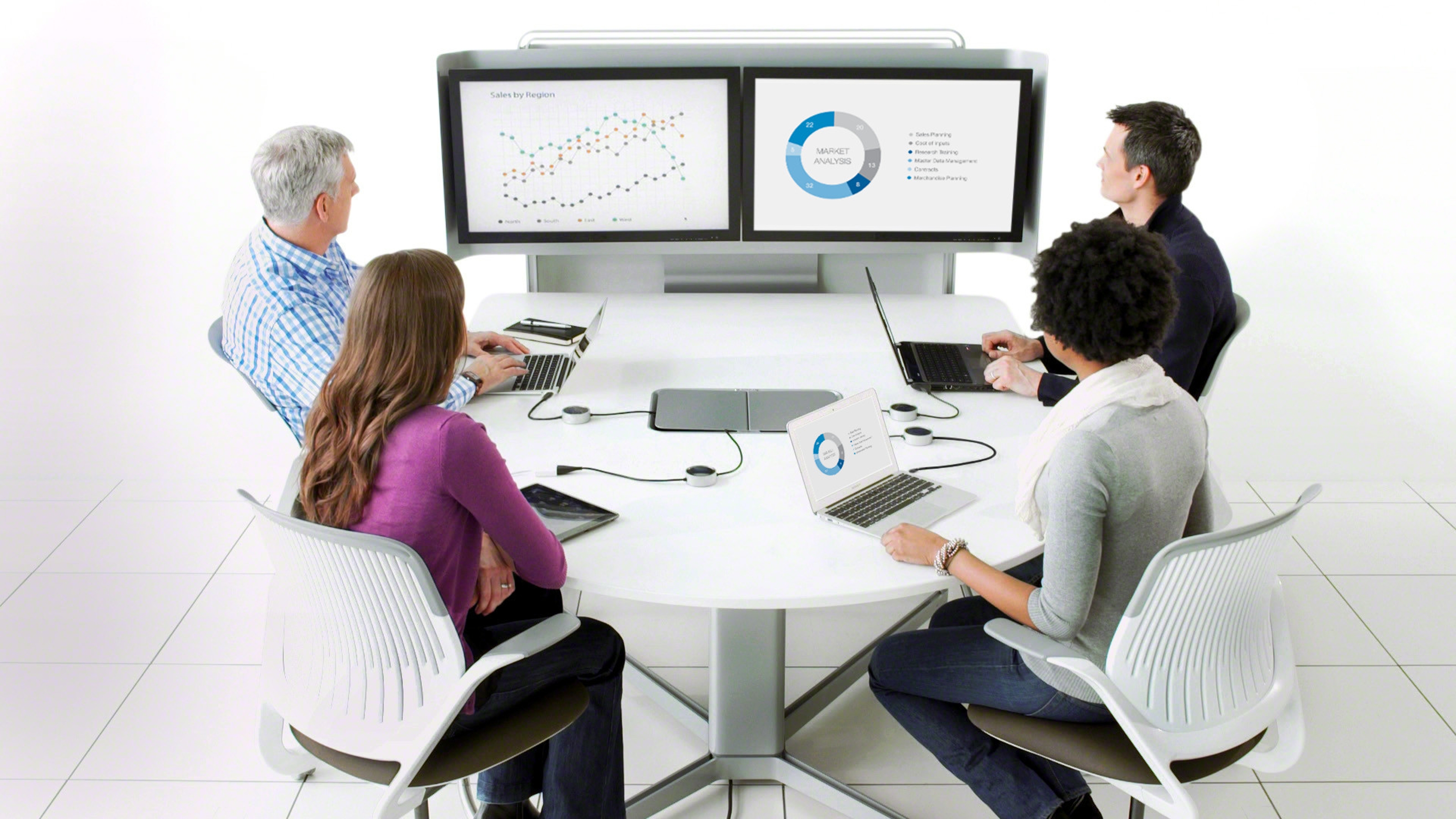
We have a couple Steelcase 'collaboration tables', some with 1 40-something inch TV and some with 2 slightly smaller ones. They basically look like this:
They are very nice to use for a few hours. My theory is that with the screen being 3-4 feet away from your eyes, your eyes are very relaxed. Watching TV vs reading a book.
This is despite the fact that they are only 1080 resolution. I'm sure we could stick 4K screens in there but I'm not sure how much more useful the resolution would be at 40".
I don't even understand the 27" 2560x1440 things that seem to be most trendy in the recent years. I tried one for a couple of days and couldn't make it work. Without scaling things are too tiny, but for a reasonable scaling that doesn't take too much quality away the resolution is simply too low. 27" 4k is a lot better, and looks ok at about 175% scaling. However I'm really looking forward to 5k and above getting more mainstream, so that we finally get good quality (like the Macbook screens) for desktops.
Ideal window manager for me would be a 2-tier affair were at the top-most tier I would create task specific groups. Each group itself would work something like the linear sequence of the OS X spaces.
To summarize the 43 comments so far: different people have different preferences, so a one-size-fits-all policy will make lots of people unhappy. Offer people a choice and if possible, allow them to try out several configurations to see what works best for them.
Here's another config I never see mentioned, but I love it. One giant 42" 4K TV. They are relatively inexpensive now (~$200) and it's roughly the same as having 4x 21" monitors conjoined in a square. It's very important to tone down the brightness and back-light considerably, since TVs are designed for sitting about 10 feet away, but they work great as monitors if you buy a good brand. Make sure your graphics card can support ultra high resolutions, and use a modern HDMI cable capable of 4K.
edit: Ensure 60Hz or higher refresh rate. This should be true if the TV is a good brand.
Most 4k tvs, or at least the 250 dollar TCL model I have, support 4k at 60hz over the newer hdmi spec. It works fairly well as a large monitor, even when sitting up close.
Personally I don't think I'll ever get a <=60Hz monitor after using one with 144Hz. (Caveat- there aren't many 4K 144Hz models the last time I checked, and they're quite expensive. I'd rather make due at 1440p, any day!)
I've been using 6 x 1920x1200 displays for several years - 5 x 24" plus the laptop's own 15" panel [1] in a corner configuration with 3 in portrait orientation (perfect for reading documents and web pages).
   _  _       _
  | || |[===]| |
  | || |[===]| |
   -  -  [=]  -
I'm so used to being able to distribute 'tasks' and workflow to specific monitors that I struggle terribly, to the point of giving up in frustration, when having to use a single display for anything other than casual or single application use.
I use a combination of head movement and rotating the chair depending on task.
The outstanding benefit is to have multiple applications and documents open and readable simultaneously, just as I would with multiple physical reference books.
An added benefit is having the same 'book' (document) open at different 'pages' on different monitors - and not need to flick back and forward between 'pages' or tabs.
This is using GNU/Linux Xorg server with 4 X sessions.
[1] Dell XPS with ExpressCard -> PCIe ViDock extender containing an Nvidia NVS420 driving 4 monitors, the laptop panel, and an HDMI connection, all 1920x1200.
Mostly bug-hunting and coding in unfamiliar code bases so I need a lot of resources instantly available in front of me to compare and figure out relationships.
However, it does make remote sys-admin safer too in that I can assign remote hosts to specific monitors - avoids the risk of accidentally issuing commands to the wrong target!
This makes a lot of sense. Going from two monitors to ultrawide, I miss the easy context switch of swapping between monitors. Being able to compartmentalize different tasks to different monitors is practically ingrained in my DNA at this point.
With 6 monitors I think I'd struggle to remember what was on each screen and have my head and eyes constantly scanning around! Kind of reminds me of those people that run Windows with no less than 42 shortcuts on their desktop!
2 separate monitors is almost always going to win vs 1 ultra wide monitor.
1. You can orient them independently.
2. You can position them in ways that are more suitable to your environment. For example if you wanted a small gap in the middle to fit an eye level web cam, you can do that.
3. If you put them flush together, 2x 24" inch monitors has roughly the same head movement requirements as a single 48" monitor.
4. 2 monitors gives you the option to do a GPU pass through VM which is extremely useful in some cases (running native Linux but wanting native Windows performance for certain apps without dual booting).
5. It's usually easier to manage multiple applications using native window snapping tools. It's also easier to ignore a 2nd monitor vs the 2nd half of a single monitor.
They are measured diagonally so the width of 2x24 is not the same as 1x48. Also the bevels do take up a noticeable amount of space, but will likely get better.
I definitely agree about the window management though. I went from 2x27 to 1x34 and found it much easier to organize windows on the two displays.
Good call on the diagonal measurements but it's not a big difference in the end. Both of my monitors have about a 1/4" inch bezel. So there's 1/2" of extra space and this monitor isn't made to have slim bezels. If you need to move your neck to see an extra 2 inches, that's not really going to make a noticeable difference in the end. You can also choose to sit back a fraction of an inch further to fit more in your field of view.
> Good call on the diagonal measurements but it's not a big difference in the end.
This makes a huge difference. 2x24" will give you half the total surface area of 1x48". For example, if you have 2x24" side-by-side, you could put another copy of that pair above the original pair (to get a 4x24" grid), and that would be equivalent to having a single 48" monitor.
If you cut your current X inch monitor into 4 quadrants, each quadrant is diagonally X/2 inches. So having two of those would be like having just the bottom half of your current monitor.
In the original article they are talking about Ultrawide single monitor setup. In practice, all ultrawides don't have the same aspect ratio as normal wide minitors (16/9 or 16/10). I have seen ultrawides from 21/9 to even 32/9 (just search for ultrawide, I'll not provide links). So it's not as easy as to divide 48" by 4 to get to 24".
Also, only very expensive setups give good resolution, to not waste all the metric space.
I find #5 a disadvantage as with 1 widescreen monitor I can easily snap an app perfectly in the center of my vision and ignore the edges. But with two monitors, if I’m ignoring a monitor that means my neck is angled the entire time or I’m physically adjusting or moving monitors.
This is an area that could use some work. I use MaxTo on Windows to set up snapping regions on my 34" ultrawide. It's pretty good but I sure think it would be better if it was built into Windows.
It’s a similar story on mac. There are multiple third party utilities to help snap windows to predefined areas, but it seems like they are fighting the OS.
> So, why do we spend money to display several things at once?
Because there's a higher cost to switching windows than just switching where you're looking.
This isn't just a developer / office worker debate, the aviation industry has done it too. Having dedicated displays is almost always better than having to cycle through windows until you find the one you want.
I guess it depends on your usage. Under my tiling setup I usually already know which "workspace" is the one I want, and how to summon it directly with a key combination. No cycling.
I find it quicker and easier to change workspace than to turn my head. For me there is one optimal display position, so I always want to be using it.
I also might have 10 workspaces, but I don't have 10 displays.
In the past I have used a three display setup where the workspace I summon gets pulled to the centre display, swapping with other workspaces, which may be displayed on the peripheral displays. However, I found that I never really liked looking at the peripheral displays while I worked, so I switched to using a single display.
I gave up on multiple monitors because I can't carry them around with me and many times I like to work away from the desk.
As a result I'd find when I'm on the laptop, my work flow would deteriorate because I'm used to multiple windows rather than the alt tab sequence.
So I made the decision to only use a 15" screen for everything, heavily depending on alt tab.
As a result I've developed a muscle memory where there is zero thought alt tabbing to any window.
This keeps my eyes in the same place - which decreases the tracking/fatigue involved and less context switch.
However, using a second monitor does increase productivity when using a monitor behind the laptop for multiple log tails - mostly because 15" is not enough to show that data.
They only had 3 participants. You can’t make any claims or generalizations from these results since they will likely be caused by individual differences of the participants. There may also be ordering effects.
Not to mention that we don't know if people naturally adjust to their environment over time so those "efficiency" gains disappear as users adapt to the environment (eg virtual desktops). Also no indication of operating system or task involved.
Everybody has different preferences and needs, I don't think there is a golden standard, but here is my setup.
4x27" (not retina, sadly I don't have the budget for this).
They are all horizontal, with 3 at the bottom and 1 at the top.
    A
   BCD
- C is my main monitor, I use i3, and my current focused app is always fullscreen, code editor, terminal, kicad, firefox (like right now). Nothing really new here.
- B is my "put it all" monitor, on it I have multiple i3 workspaces, with IRC, Slack, riot.im, twitter, chatty, discord, toggl time tracking, spotify, music player, keepass XC and a few other utilities. All apps on monitor B have notifications muted and I cycled them (the social ones), like once every hour or two hours. I hardly every look at B except when scanning social things and changing music. When working B is just black.
- D this is my secondary working monitor. Browser with dev tools, 3d preview, datasheets, documentation... all this goes there.
- A this is the persistent monitor. If I'm monitoring (eg trying to find a performance bottleneck in an app), I'll have a grafana or whatever graphs on it. Or a log tail, trying to find a visual pattern in the logs (sometimes it happens). Anything that has to persist through the day or even the week. If I don't use it (like 60% of the time), I put some ambient images on it, like this video https://www.youtube.com/watch?v=e4CQHzLAi8o
Wait until you get to your 40's or 50's and your eyes lose the ability to adjust their focus distance. This will change everything.
First, you should get two pairs of glasses, progressives for general use and single vision lenses tuned to the specific distance to the monitors you use.
Since I use a ThinkPad for much of my work, my computer glasses are adjusted to a focus distance of about 20".
This means that all my monitors, in whatever configuration, also need to be about 20" from my eyes. And it means that large monitors are unusable unless they are curved, because the distance to my eyes changes too much from center to edge. I tried a 32" flat monitor at a company I was visiting a few years ago and it was hard to keep everything in focus.
My vision does correct well, so as long as I can keep the focus distance constant, small high-DPI monitors work best.
The sweet spot for me is the high-DPI monitor on my ThinkPad combined with one or two 24" 4K UHD external monitors. One external monitor is centered above the ThinkPad display in landscape orientation, the other is to the side in portrait orientation. The external monitors are also 20" from my eyes.
If I only have one external monitor, I like to have it on a mounting arm so I can use it in either of those orientations as needed.
Each monitor is positioned so the screen is centered relative to my eyes (i.e. I'm not viewing it at a slant).
By sticking with small monitors and adjusting them to all be at the same distance, I can easily see everything on all two or three of them.
Whatever you do about monitors, take care of your eyes! Don't do what I see too many people do, where they avoided getting glasses long after they should have and squint and crane their necks to try to read the text. Or even worse, they only get a pair of progressives, so when they try to read the screen they have to tilt their heads back and aim their eyes down through the close-up part of the glasses.
Getting proper prescription computer glasses - and getting the prescription renewed every couple of years in my 40's (when your vision changes most rapidly) - was one of the best things I ever did for myself.
Laser eye surgery does not restore your eyes' ability to dynamically change their focus distance. Age will take that away regardless.
I have heard of people getting laser surgery where each eye is adjusted differently, one for near distance and one for far. In fact, that is how my eyes worked naturally for many years: I had good close-up vision in and good distance vision in the other.
This did let me avoid noticing how my vision was changing for some years, but it meant I was only getting clear focus in one eye and blurry vision in the other. When I got my first computer glasses and I could see the displays with both eyes, it was like night and day.
I've also seen references to new procedures that use multifocal implants, so you would essentially have some kind of progressive lenses in your eyes. This sounds terrible for computer use.
I don't see how any kind of surgery could give me the usability and flexibility that I have with my progressive glasses and computer glasses. With the computer glasses, all of my displays are in perfect focus with both eyes. And the progressives are perfect for other everyday activities - driving, reading on smaller devices, etc.
I like the ability to tune my vision to these different needs. With surgery it seems I would have to pick one or the other.
Imo. it comes down to the window manager, with regards to productivity.
One ultra wide (I got the Dell 38") has the added benefit of making it possible to have the primary app in the center, with less important stuff occupying the far ends of the screen.
So much more has to do with window managers, software choices, etc than simply the number of pixels you have on your display(s). I find that reading long lines of code is more comfortable on my 1920x1200 Dell desktop monitor than on my ThinkPad’s 1366x768, but my productivity has a lot more to do with the WM and Emacs configuration than number of monitors.
That's my setup, 3 vertical 24" monitors. Same benefit as having the 'main' thing in the middle on a big screen. Text editor takes up the full middle display at most times, a terminal (or stack of terminals) to the left for compiling / examining debug output, and the rightmost display is for hacker news. I look at the rightmost display too often.
In all seriousness the tiling window manager I use (xmonad, but any other would probably do) is more important than the number of displays I have. But it is nice to be able to use 2 vertical displays side by side to do an eyeball diff of output at times, or to keep reference material visible on the display right by the code I'm working on.
Any change in the way I work is going to screw me up if it's not incrementally added. You don't just add a 2nd monitor, you significantly change your workflow. Maybe you add the 2nd monitor and don't use it at first. Then as you get work done, you drill on experiments to mine for improvements.
Some people are also more open to exploration than others. It amazes me when I show a gray beard (getting there myself actually) a new trick using keyboard shortcuts which have been shipping in that system for many years. I get that way myself at times, but I'm trying to get better at actively searching for improvements on my workflow, especially using tools which ship with the box I'm using.
If something like a 2nd monitor greatly improves your performance, then I imagine you would be able to improve just actively trying things. Otherwise it would be like adding a 2nd gearshift for a pro stock car racer. WTF am I supposed to do with that? It's going to take me a while to add it to my workflow.
> Naturally, when working with two monitors, you have to turn your head more often. [...] Therefore, while working on 2 monitors may require massages or physical exercises to reduce neck strain, one monitor is lean and mean.
My personal experience is the opposite. With just one screen I tend to sit still in one position for long periods at a time and feel really uncomfortable after a couple hours. With my current 3 monitor setup I not only turn my head frequently but even sit differently depending on which screen currently has main focus and which one is e.g. just showing debug info or logs.
> Three people were selected for the study: the first person received a 24” monitor, the second participant – a 25” monitor with a 21:9 aspect ratio, and the third participant – two 24” monitors. The study lasted for three weeks.
This study is seriously flawed in another way. I'm assuming that the 24" is 16:9 which has a height of 11.8" The 'larger' 25" ultrawide has a height of 9.8"--I would hate working on that for the same reason I don't like 16:9 laptops--the height of 16:10 or 3:2 are so much more useful.
Hah, yeah. I felt pretty dumb when I realized that a 40" LCD is about as tall as a 29" 4:3 CRT (est. from memory), so SD video on the LCD is no bigger than I had 20 years ago.
Peripheral vision helps with anchoring where and what something is. If what I'm looking at suddenly changes to something else, there's a moment of disorientation, too brief to react to, but still enough to interrupt my train of thought. If pressing cmd+tab didn't actually produce the very next thing I needed to see, this is even worse, since now I need to consciously decide if what I'm looking at is the right thing, press cmd+tab again, wait until I understand what I'm looking at, etc. I feel confident that this is not a problem unique to me, due to the existence of extensions like https://marketplace.visualstudio.com/items?itemName=johnpapa... , which colors window borders differently to allow reducing this delay.
If I turn my head to look at a window that I could vaguely see in the edge of my vision, there's no such disruption, at least consciously. It feels as though turning my head doesn't require any conscious attention at all, unlike the "what am I looking at? Is this what I expected? What was I thinking?" process that happens with hidden-to-visible transitions. By the time my head has turned to bring the window on the other monitor into the center of my vision, I already have the visual context, and in the meantime, I haven't lost my train of thought.
> Three people were selected for the study: the first person received a 24” monitor, the second participant – a 25” monitor with a 21: 9 aspect ratio, and the third participant – two 24” monitors.
The "ultrawide" monitor in this test is 1" bigger than one of the 24" monitors.
How the heck does this get counted as some kind of valid "ultrawide" comparison? Doesn't seem legit at all. :(
One benefit of having a single monitor (ultrawide or not) is that when you end up working on the go on your single-screen laptop, you don't lose much productivity in terms of environment adjustment. It also helps focusing on a single task.
With that said… I did buy an ultrawide monitor in the end (which allows 2, or even 3 apps to co-exist side-by-side). But I still kept my old monitor as a secondary one (mostly for iTerm, Spotify, and live sport).
So to answer the question: two monitors or one ultrawide, I would say, why not both?
Lots of comments around the study...i will give my monitor thoughts as I think they're vastly different than most.
My theory is that I'd like to achieve productivity no matter where I'm at. This means I don't use more than the laptop's monitor. I've gotten really good at using workspaces to keep tasks separated and use 3 full screen "desktops" in Mac for my standard Dev flow. I never move my head to trigger a change in flow, just a quick swipe. Also every window on a desktop must be visible in some form if multiple programs are in 1 desktop.
I've never had a complaint about my performance although I don't think it would matter much if I had a different but efficient flow.
I do have some colleagues who have tried this but they don't follow rigid organization and so they can't find their windows well.
If you'd like to do away with touchpad gestures for an even faster workflow on osx, try using https://contexts.co for your switcher, and https://www.alfredapp.com for your launcher
contexts gives additional 'switching' options on different hotkeys, window searching+selection, and no mouse interaction required (but it is supported)
I have Contexts setup as follows:
    cmd-tab: cycle thru all visible windows of all apps on this desktop

    opt-tab: cycle thru all apps on all desktops


    cmd-~: cycle thru all windows of focused app on this desktop (include hidden/minimized)

    opt-~: cycle all windows of focused app on all desktops (include hidden/minimized)


    cmd-space: activate Alfred

    opt-space: search/activate of all running apps on all desktops
This workflow allows for complete, keyboard-driven navigation/switching, and total deprecation of the slow 10.7+ mission control gui (you can restore the older & faster exposè style window view with the app TotalSpaces)
I am going to check this out, it looks interesting. I haven't really experienced inefficiencies with the speed of mission control, but I'm open to better ways of interacting with the workspaces and applications.
1. Sample size of three people (one per monitor arrangement).
2. A 25" 21:9 ultrawide is not comparable with 2x 24" 16:10 screens. You'd need something like a 44" ultrawide to get the same screen width (omitting bezels)
Indeed it's not as wide as 2 monitors, but you can split workspace into 2 applications and that's still quite comfortable. E.g. when working on web-development you might have VS-code and browser opened at the same time.
I know what you mean, I have used 34" and 38" UWs and they feel large enough. But a 25" UW is tiny and actually has 12.59% less space [1] than a single 24". And most run at just 2560x1080.
For years I ran 2 1080 27's - one portrait, one landscape - off of my MacBook Pro. Last year I decided to try a 28 inch 4K at work, which led to purchasing a 30 inch 4k at home. I also purchased a laptop stand so I can put the laptop off to the side and stow Slack or Spotify over there.
For me, the higher resolution on a single wide screen makes me far more efficient. I can tile 4 windows or 2 side by side and, as others have indicated, not be turning my head constantly. Plus, when using the dual 27s I still naturally tended to push lesser used apps over to the monitor not directly in front of me, so the single ultrawide and laptop stand was not much of an adjustment workflow-wise, but was a huge boost in productivity for me.
YMMV of course, but I've seen a lot of benefit going the ultrawide route.
I love my 43" 4K monitor not because he just wide, he also does give me much more verical space. I don't sit in the center, I sit about 1/3 on the left side.
I love mine as well. To me it is working with Windows the way it was envisioned, where you can place documents and tools where you want them as you would on a desk. You can even see your "desk" (wallpaper) in the space between documents. I shove my calendar and chat up high where I can easily see them, but they are out of my way.
One display is also no muss, no fuss. The time wasted on fiddling with displays, layouts and dealing with OS (oh Windows..) issues can negate the benefits of multiple monitors especially for less technical users (forums are filled with people who can't figure out the rules for HDMI/DP resolution combinations for their computer).
Speaking of Windows, the only real problem is that window snap doesn't allow me to set a 70/30 split vertical and horizontal instead of 50/50. Tried many different tools, but none seemed optimized for Windows 10.
I run a 43" 4K at my office, and have to conclude that I'd prefer more horizontal space (thus 2 smaller screens side-by-side, or an utlra-wide).
I contribute 2 reasons:
- The vertical space on a 43" is too much, you have to tilt your head up to see the upper region of the screen, which is not ergonomic.
- I currently run MacOS, which has horrible window management, as a result I regularly find myself piling up a whole bunch of windows in the lower center of the screen, leaving about 1/3 of the screen unused.
Situation: sitting desk, 80cm depth, sitting in the center of the screen, MacOS with stock window manager.
I'll probably hang this 43" on the wall as a dedicated grafana monitor (who doesn't love the eye candy) and place a ultrawide on my desk once I replace my aging apple laptop with something more capable of driving such display.
I also rarely use the full height from my 43" monitor. I have an 32" monitor beside from another machine, but I still use mostly more vertical space than the 32" monitor would give me.
A big plus is no scaling, so no problem with my Windows Notebook (rarely) or Linux (main machine).
Ha, I do almost all my work on a 14' laptop. Plugging it into a spare monitor is just too much of a hassle, and I've grown used to the screen economy. The way I get around such a small screen size is to have multiple workspaces open on i3 -- one for the code editor, one for docs, one for messaging, and a bunch of other ones shelved around. Flipping between workspaces is pretty painless since it's just a keyboard shortcut but I wonder how much time I lose by getting distracted when I have too many workspaces open.
I used a 4k 40" monitor for a few years and now I'm back to the 27" 1440p Apple thunderbolt display that I had before. I have another 27" like that I could use but don't. The 40" gave me rsi and I spent a lot of time moving windows around (split the screen in three columns mostly) as working on the two edges strained my neck. Using an additional monitor with either the 40" or 27" also strained my neck and having chats be always there (since the second monitor was not much use for anything else) was distracting. The point is, bigger and more are not always better. One 27" is perfect with side by side windows and switching apps with quicksilver on a mac. I'm switching to Linux now and hope to find a similar app or hotkey setup where I can open or switch to a specific app with one hotkey or key combo. I may consider a 30" curved or so in the future but even that seems like it might strain the neck too much.
There seemed to be an assumption that someone on a single monitor would tend to use the whole screen for a particular program. So this might be specific to a particular, undefined, windowing environment.
Here I am, finding multiple monitors distracting....
I splurge on one monitor with the best display I can get, preferably high res and 16:10 aspect ratio for more vertical space.
I find the simplicity of my setup soothing in a way, and lets me focus on one thing that is dead straight in front of my eyes and not get distracted by peripheral vision.
> Naturally, when working with two monitors, you have to turn your head more often. When working with two monitors,
I’ve also noticed I move my eyes a lot more with bigger screens. Notably working on a dell 34” ultrawide. Whereas small screens - even down to the MacBook 12” - with efficient use of alt-tab and Alfred can be very productive. You don’t loose time looking for something. However when you workflow needs two side-by-side panes but no more, 27” is a bliss.
In my experience in web development, coding usually needs 2 browser windows with 10-20 tabs, 5-6 terminal windows, DB GUI, text editors with 2-3 related projects open, logs views, OS task monitor, and a couple of misc. apps. Might as well work on a small screen with less eye browsing but efficient use of keyboard shortcuts if context switching is that high.
I've come to love single monitors. It is like a task mode for me where I'm only looking at one thing at a time. I use multiple desktops to quickly change between applications or views. It really removes a lot of the urge of distraction for me.
Nice to see some quantification and hints of where the point of diminishing returns is reached. Counting tab/window switching time and neck moves seems like a decent start, tho seems moving the neck or chair is quicker.
It's been obvious since the CRT days that the biggest possible monitor was best. Anything smaller was like trying to navigate through a porthole instead of the broad seascape visible from the bridge.
The ultimate in some SciFi scenes, a large curved desk-monitor surround, though past the point of diminishing returns for most tasks, still seems cool for very complex tasks, or large CAD work...
I've used one 30-inch monitor for the past decade. if I try to use more than one monitor, I get vertigo when the mouse crosses from one monitor to the other and is in the least bit out of alignment. And I am someone who did a lot of code development on an ADM 3 monitor in the late 1970s to early 1980s, but I am very prone to motion sickness.
I cannot stand laptops in general. It's amazing how much functionality can be packed into them but the first thing I do with a laptop is plug it into a full-size keyboard, tracball, and monitor.
While two monitors with a standard window setup might be more productive, tools like Bettersnaptool or Magnet, which allow you to position your various open programs evenly on one display, will absolutely be more productive than multiple monitors.
My setup (tried and testing over the years), is one 27” high resolution display and Better Snap Tool. My laptop is in clamshell when connected, and BST allows me to use keyboard shortcuts to position my working windows. I have everything in one display.
I really like this video about the best way to setup two monitors - it compares price, ergonomics, productivity, aesthetics and desk space usage for all the various ways to setup two monitors
Went from two 27” thunderbolt displays that were side by side, to two Dell 38” stacked on top of each other. With the bottom monitor closer to the desk and the chair a bit higher, my eyes are at the top center of the bottom monitor and I’ve noticed my head doesn’t go back and fourth and my eyes can cover the vertical space pretty easily.
Looking forward to some high dpi 38” monitors over the next few years.
I would be a little concerned about the ergonomics - any slight deviation from the heads central balancing point on the neck (i.e. looking slightly up or down) over a longer period can cause neck strain with the associated problems.
The ideal position of a monitor is with the top directly in front of your eyes when your head is perfectly upright.
That said you obviously don't have to turn your head as much, which might make up for that.
Yeah I used to have a 2-28" side by side with a top 28" on arms and I really didn't like it. It caused constant neck pain no matter how I adjusted my seating position and I wound up rarely even using the top monitor. I initially figured I'd just keep spotify/media on it
Back to 2-28s now. Debating on getting 1 49" but I'm worried I'll miss having two completely separated monitors.
When I have two monitors side by side I tend to use one monitor exclusively for a significant portion of the time.
But when working on web applications, I do prefer to have the browser on one monitor and the editor/terminals on the left, and I do believe the latter improves my productivity. I haven't tried this with a split widescreen yet.
* I can sit and look in a symmetrical centered way. previously one screen was always "main" and I would naturally keep my head rotated more often left than right causing neck pain
* the btt view allows me to have all kinds of flexible layout, see https://i.imgur.com/wHyS3HP.png for my webview setup. every color is a different kind of layout, dark purple was intended to be most often used and thus easier to reach (webview opens with mouse in the middle). But I have noticed that i rarely use the 60% middle width one so might change that
* if i read something i can put it center view, roughly 60% width
* widescreen allows for 4 windows with somewhat normal ratios in each corner. do that on a normal screen and they are way too narrow for e.g. browsers, editors with sidebars etc.
* curved screens are super nice
* i exclusively use a single iterm2 hotkey window, single screen means all is in one place and it just fits more. with two screens i would have to designate one for the hotkey overlay. 2x4 terminal sessions seems like a great fit for most things
things i wish were differently:
* its not yet possible to get real high dpi on widescreen. 2x4k screens are nicer here
* btt will only allow modification of window dimensions of the currently focussed window, not the under the mouse location when pressing the webview shortcut (middle mouse for me)
Does anyone know why linux is so bad with multiple monitors using multiple GPUs? I only have NVidia cards but I can only ever get 1 GPU and the intel integrated graphics to work simultaneously. Is this a limitation with drivers, X11/wayland, the desktop environment? Any hints would be appreciated!
The arguments against two monitor setups or focusing on two different things seems to be completely opinion based. Of course if you're checking your emails then you might want those front and center.
But for me, I work in auditing and I'm constantly looking at two documents at once, comparing documentation I have against my workpapers. And when working out at a client site I cannot stand using one screen, having to switch between documents every 5 seconds, constantly trying to fit two documents side by side on my screen.
My opinion is that two monitors are better than one, but any variation of that is simply personal preference. Side note, I also think that working with ultrawide curved screens distort the image on the screen too much.
I moved from 2x 23" 1080p monitors to a 32" 4k monitor with 100% scaling, and vastly prefer the 4k monitor. I have effectively quadruple the screen space, but with the option of extra vertical real estate without the visual barriers of bezels.
On my laptop I'm stuck with a 1080p screen, but I run i3wm which significantly improves the experience by maximizing my usable space on one screen with easily switchable workspaces.
I've gone through a number of monitor setups, and at home I settled on a single 27" at 1440p. That lets me maximize applications like GIMP for maximum use of space, or have two 1280x1440 windows maximized side by side for comparisons or multitasking. If I need a dedicated space for something, I'll open a new virtual desktop.
At work I did use three 1080p monitors for a while (I do a lot of data analysis and comparisons), but I realized that I hardly ever used the third monitor, two displays of that size seem to work best for me. I think I would be okay with a single ultrawide monitor of similar or higher total resolution.
I think the most important thing is to let people find the setup that works best for them.
I used to run 2x 24" monitors in portrait mode (2400x1920) which was pretty nice.
I upgraded to 27" monitors, but portrait mode (2880x2560) involved too much head tilting so I ultimately went landscape (5120x1440), which was both too short vertically and too wide horizontally.
So I'm currently using a single 30" (2560 x 1600) in landscape mode. It's ok. There's simplicity in having a single monitor.
The next (and possibly final) upgrade will likely be to a ~32" 4K or 5K monitor. If I had a 2nd monitor, I'd probably just want it to mirror the first one at 3x zoom centered on the cursor - my eyes are losing resolution about as fast as monitors are gaining it.
On my little experience, dual monitors is better that a single ultrawide.
I had a ultra wide on my personal computer and two 16:9 monitor on my workstation. Same OS, same desktop setup, doing the same stuff. The total area and resolution is nearly the same . I know how explain, but I feel that I have more organized the open applications using two monitors that a single ultra wide monitor.
However using the ultrawide to watch cinema movies (without black bands.. Netflix I'm watching you!) or playing games that support correctly ultra wide resolution it's a pleasure.
Linus Tech Tips just had a video on 49" 1440p Ultrawide monitors with glowing praise, which has me considering purchasing one to try it out.
I currently have a 32" 4k and its the perfect resolution and vertical height for me, but could use more width.
Side by side monitors is out for me as I don't like having a bezel in the middle of my view, and vertical monitors are also out for me as viewing angles are terrible- and just moving your head side to side can cause brightness/color saturation to vary wildly - seems as viewing angles are designed for landscape orientation.
I recently replaced my main 4k 28” monitor with a 2k 13” portable display, which is the same size/density as my laptop. Many people are surprised this is my main setup, but I can view all the windows I need active at once (using i3) and retain the exact setup whether I’m home or mobile.
One major factor for me was glare. There’s no way for me to position the 28” panel without a giant reflection unless I darken the entire room. With the smaller panels I can easily position both for zero reflection.
Now the 4k sits to the side for charts/monitoring, attached to a NUC.
Am I the only one who has two 27" monitors, but doesn't have to turn his head to look at them?
Mine are set up so that one is in front of me as normal. The other is tilted between the bottom of the first monitor and the front of my keyboard.
Pros: I don't have to turn my head side to side or upwards to see all of my screen real estate. I found that holding those positions too often bothers my neck and eyes, but looking down doesn't bother me at all.
Cons: You lose a lot of desk space. Cleaning underneath the bottom monitor can be a pain.
If you haven't already, look into spring-loaded or hydraulic articulating mounts for your monitors. MountIt makes cheap stuff that's pretty good for the money. Saves so much desk space and the monitor can be very easily moved out of the way for cleaning or desk work and then positioned back with minimal effort.
I've got 2 x 27" portrait monitors, total screen area ~70cm wide x ~60cm tall. Similar sort of area. It's odd, because I actually found even a single 27" landscape monitor rather uncomfortably wide! - but for some reason my current setup has never bothered me, and in fact I'd add a 3rd if my laptop could drive it.
I have one straight ahead of me, and I do have to turn my head a bit to look at the other one, but I don't find it troublesome. I don't really like working that way for long periods (e.g., when writing code in a text editor), but it's fine for command line stuff, and good for documentation.
I'm struggling to visualise this setup - it sounds like the bottom monitor is tilted within a height of a few inches, and I can't understand how it could be useful to look at an almost flat monitor?
I wish I could move the top monitor farther down and tilt the bottom monitor more. The top monitor is still a bit high for me. But, tilting the bottom monitor more isn't great either because of the view angles. I was thinking about grabbing a couple of 4k 17" monitors to replace the bottom 27" monitor with. It would let me bring the top monitor down and the bottom monitors wouldn't have to tilt so much.
This is an interesting layout, but I'm not sure it's for me; the main monitor looks to be too high up for me, and the perspective on the tilted monitor would irk me (I just tested this out with my laptop).
I appear to be in the minority. I use 3 24" monitors at work because it's the most I can fit on my desk, but at home I bought a 6-monitor stand and have a 2x3 grid of 22-24" displays.
It's perfect for project work - one display for the site I'm building, one for my IDE, one for 2 terminals split vertically, two displays for documentation/research, and one for messaging/music/misc other stuff.
I wouldn't ever go back to fewer displays, and only wish I had bought the 8-monitor stand instead.
Watch out your eyes health, try to look far away as much as possible if you don’t want to lose the ability to focus far away. I’m speaking from direct experience as per my other comment.
I couldn't use two monitors, as I need a focal point. It's nice to use the secondary monitors for extra things, depending on the workflow. For browser development, a browser tab and devtools on the side, text editor in the middle, everything else (spotify, filebrowser, discord, documentation) on the other side.
I used to work in finance and the traders had similar setups. I found that they started to give me information overload anxiety, I could not imagine installing one at home.
Single reasonably sized screen. Anything to the sides is just at an uncomfortable angle so I’d be dragging it to the center screen anyway if I were to work with it. I don’t have screens with read only information I need to monitor like say a trader, game developer or Ops person.
I have lots of colleagues with multiple screens that use them to spread out their slacks and mail clients and whatnot. I have no idea why you’d deliberately put a distraction at the periphery of your vision!
It also depends on the type of work. If you work on data analytics projects, you probably will need more screen space to fit: code, console / logs, plots, data frame. If you work on web / mobile development, you probably will need less screen space to fit: code, web browser / mobile simulator.
The problem with two monitor setup is that nothing can be at the center, things are always on either left or right side. Ultrawide is great but I hope there can be something wider than 21:9.
Current setup at the office is a 28-4k dead-centre with laptop stand beside it. I use the side display for Slack and Spotify specifically to not look at.
At home I had a 28-4k but replaced it and my TV with a 43-4k. I mostly use the middle area so a single ultrawide with laptop below it would suit me fine if it wasn't my TV. The PiP is handy for using multiple machines.
Edit: when I was doing production engineering, I used two 28s, one vertical on the side with the laptop on the other side.
I currently have 3 27" displays side by side and keep wanting to try a giant 40-50" tv now that the bridge between monitors and tv is getting so small. (Plus I would kill-9 for PIP)
What model do you have, (did you try a few) and what are any real life downsides? (Eg. No usb hub? Display just not quite as good yet?)
Surprised this approach hasn't come up more often yet
I got an LG 43UD79-B after asking here[0]. Built as a high quality monitor rather than a low-end tv. PIP as well as 2x or 4x P-by-P with USB-C (video+hub), DP, and 4 HDMI.
My setup for the past 2 years has been a 34” 3440x1440 Dell Curved Widescreen on max height with my 15” Macbook in front.
Combined with MacOS Spaces it’s perfect productivity wise. Extra screens would just be Screen sprawl. Learned something new today ;-)
IDE on the Macbook, browser on the right, 4 terminals on the left. Slack, Messages, Email, Calendar and others are all on a different Spaces screen for minimum distraction.
I live-stream code sessions with OpenBroadcasterStudio. I use one monitor for my work and the other to monitor the stream. On the work monitor, I split the window evenly between editor and output (web browser with browser tools), and find the OS shortcuts for arranging the windows to align to the edges and split the screen really helpful for efficient use of the screen space.
I use 3x 24" monitors, all side by side horizontal with a minimal bezel and love it. I generally have email open on my right monitor, web open on the left, and productivity center. Works well for me considering it's my "office" computer, not my development computer. Dev has 2x 24" horizontal, with a VM on the right and Windows on the left.
At home I've been using one 1080p 23" monitor and one 32" 4k . the 1080p is in vertical position on my left side, i keep chats there and do work and browse the web on the 4k..
At work up until 2-3 weeks ago at work I had 2 x 1080p monitors, and going from home to work felt crippling.
So i would recommend to anyone doing any type of work to get at least one 4k 30+" monitor!
Other angle is the role of text. I have now a 32 4k, before iMac + 32 tv HD.
As pixels, the 32 4k is MUCh better, BUT, for reading and see things, I actually downscale to almost Full HD (can't see UI artifacts and despite OSX is better than windows, a lot of things not look good with increased text fonts).
The need of multiple monitors, for me, is to dial the text..
I tend to use 1 monitor most of the time, but when I am remoting onto a machine, or running terminal sessions, I tend to switch on another monitor and put the remote session on that, this gives you a nice mental separation. I have seen people wasting plenty of time moving stuff to another screen when a simple alt+tab is faster!
Any suggestions for good monitors to use in a vertical orientation? I notice that the LG monitor they sell at Apple stores (the smaller one) cannot be rotated on its stock stand. Maybe one can achieve this with a VESA mount + arm?
But that's an expensive monitor. Any suggestions for others? High DPI would be nice, I'm so used to it.
I use a 27 inch 1080p and a bigger 4k monitor and I can't get the scaling right. I'm considering selling one or the other and getting a new one so that both share a DPI.
I wish Wayland was more stable so I could use it bug free and get some of that fractional scaling working
If I was Ozymandias being alone with the world I might consider some of these setups but I prefer just having a crappy little screen because I figure the user's setup probably looks more like mine than anything really good.
Not sure I believe in the detrimental health effects of having two monitors as described in the article. I also don't see how having an ultra wide monitor reduces left and right panning of the monitor with your neck and eyes...
I use an ultrawide with a common-sized 1080p off to one side. Work gets done in two or three columns in the ultrawide. The smaller side monitor is for music, api docs, Slack and other background tasks.
For what it's worth I was using 3 monitors and it gave me a SEVERE neck problem that only resolved itself when I got rid of the setup and went back to just one.
There are so many variables effecting these decisions.
1. Work activity
I would never record music, with only one monitor, because I use many programs, which are synced, and have LOTS of buttons and faders and valuable information, in -real time-. That makes the time spent adjusting settings, while replaying the same parts, using plugins while recording an instrument alone etc., a very dissatisfying experience.
Gathering information on the other hand, for me is easily accomplished with one screen. I then just snapshot every interesting/relevant peace of information with key combos, and look through it in bulk, afterwards.
Browsing the web, while chatting with friends, watching some youtube videos and listening to music, is for me doable on a single screen, since I use a tiling manager, but I still prefer the second screen available in this "idling" scenario.
I also have a monitor vertically oriented, to get more text without scrolling down, on ex. email, hacker news, and other text based applications and websites.
2. Health of user; I have trouble sitting in one position for longer amounts of time. Airplanes are a hazzle, so are boats and busses. Anyhow, this forces me to move a lot and change position, which in turn could just as easily be combined with moving my head, and still be beneficial to me, health vice (and I have not seen studies showing static sitting posture and head placement, to be lean and healthy).
3. Type of work
If you work with computer administration of live data of any kind, a vertical monitor to watch alerts, changes, numbers and data - will in my experience, be more informational than a horizontal monitor feeding the same information. I understand this is also due to Graphical representation of given data, but still, It seems easier to similar information in columns.
4. User capacity
Not all users can take advantage of their WM.
Not all users can take advantage of the extra space, with two monitors.
If the user do not adapt to the given setup, they will off course be better off, keep working as they have done and are used to. It is like giving someone a keyboard driven tiling window manager.. Some will thrive, learning the combos and adding their own. Others will rip out their hair in frustration, claiming tiling wm's are dumb, inefficient and just not giving any advantage in regard to work tempo.
5. Proparbly lots of other similar arguments going the same way.
I therefor conclude; there IS NO best monitor-size or amount of monitors. It depends on the work, the user, and the userspace.
Yes, this is not a study. So many problems with this. Measurement of outcomes, what tasks? N 3 ridiculous and should not be published at all, or believed (even if it might be true in an actual study)




A few others in the company use one or more vertical screens too. Those of us who do, certainly like the increased vertical space.
Quality of window management is also going to be an important factor: of the two main OSes: Windows is good at simple window-per-screen and two-tiled-windows-per-screen arrangements; macOS is fairly weak, being more inclined to manually accomplishing it. (I’m on Windows for now, but I’m planning on trying Arch Linux, which I previously used, on my Surface Book, as it’s now probably good enough to work with. With Sway (i3 clone for Wayland), its handling of such a screen arrangement will be superb.)