The community design is an "and", not an "or". The Galaxy Tab model which had issues with this in Germany, if you look at it, has all, not just one, of those characteristics. The "Apple thinks it owns the rectangle" meme is nice, but untrue.
Nilay Patel, in the Verge article linked by Android Community:
Now, some of these are a little ridiculous when taken individually — is Apple going to sue every digital photo frame maker that puts equal size black borders around the screen as well? — but in the end, the main question for the court will be whether or not Samsung has used all of these elements in a way that's likely to confuse consumers about what they're buying.
Protecting customers from misrepresentation – unknowingly being sold something that does not match the logo stamped on it: fine; protecting a megacorp from its competitors selling something with similar design, but a different brand name: customers lose.
That's a reasonable opinion, but it's not how that type of intellectual property works. Again, Nilay Patel (a lawyer, fwiw) at The Verge:
Trade dress is the wonky red-headed step-cousin of the family that fills the gaps between the three; you might think of it as a trademark on design elements that trigger consumer recognition. [...] Apple's claim is that the iPhone's box and design scream "Apple" to consumers just as strongly as the word "iPhone."
This kind of legal weapon is just emerging, and it's a product of circumstance — patent offices have rubberstamped hundreds of Apple's bevelled rectangles, and Apple recently found a court that would act on it and delay sales. It's a bit early to say lawyers have it all figured out, and that we should shut up and listen to them.
Consequences matter, the intent and spirit of the law matter — lobbying, laws, case law, patents and injunctions are decided by humans — which is why it's important to counteract the claim you quote, that this is about protecting customers from being confused about what they're buying.
Trade dress law is well-established, and Apple itself has a history of successfully pursuing trade dress claims in the Northern District of California. In 2000 the company sued both eMachines and a company called Future Power for knocking off the iMac's trade dress, winning injunctions in both cases and eventually getting extremely restrictive settlements that effectively removed the infringing products from the marketplace.
The 2011 case featured in the Verge bundles trade dress claims, that have been enforced in the past with a less simple and much more distinctive look, with design patents, which I'm not aware Apple has been able to enforce before. The other one we discussed is for a European “community design”, something which was created (sorry, “harmonised”) in 2002, and those extremely simple shapes were registered by Apple in 2010: http://www.scribd.com/doc/61944044/Community-Design-00018160...
That's trademarks, which so far have been more faithful to their stated goal of preventing consumer confusion, rather than creating new kinds of private property. For example, I don't need Apple's permission to use the trademarked word Apple, as long as I'm referring to the firm, or as long as I'm not using it in the context of electronics or music.
Well, it sort of is like artwork since they registered the design patent. At a glance, the RC Cola can doesn't look like Pepsi. Some of the Samsung phones do however look like iPhones, and infringe on all of the conditions mentioned in the patent.
This case mirrors the eMachines case where they were selling something that looked pretty similar to an iMac.
but in the end, the main question for the court will be whether or not Samsung has used all of these elements in a way that's likely to confuse consumers about what they're buying.
How can consumers be confused about what they're buying? Even if their software appears similar, one device has a large Apple logo on the back and is sold almost entirely through a different retail chain.
For what it's worth, the "different retail chain" isn't as different as you might think. Apple only sells 15% of all iPhones in the US directly. Most of them are bought through cell providers and Best Buy.
You'd be surprised what consumers can mistake a product for. In many people's eyes, iPhone == smartphone. It'd be a relatively simple mistake to make if you are a elderly non-techie.
Then they should read what's written on the box because its pretty damn clear. I mean going by that kind of thinking, one can mistake vodka and water. In fact its probably a LOT easier to mistake vodka and water than an iPhone 4 and a Galaxy S2.
Vodka, water, same color. iPhone, Galaxy S.. not even the same color. Just a vaguely similar shape. Heh.
That's very much incorrect. The SII doesn't remotely look than an iPhone 4, except both are squared... different COLOR, different SIZE, different BUTTONS...
Both are offered in black and white. Although the SII was bigger the aesthetic is practically identical. You can say that you disagree, but to suggest my statement is very much incorrect is off the mark.
So, if they ended up buying an android phone, does that really count as a mistake? After all, they didnt really want an iPhone, they wanted a smartphone, and that is what they got.
Because when you are a retail store you are only looking at the front of a device not the back. In some stores they actually have the tablets fixed to the table.
Also outside of the US (and pretty sure in the US as well) the same retail chains will sell all types of tablets including iPads.
>in the end, the main question for the court will be whether or not Samsung has used all of these elements in a way that's likely to confuse consumers about what they're buying.
I don't believe design patents hinge on whether the consumer would be confused; that's for trademarks. Design patents are for protecting the aesthetic idea, just like regular patents are for protecting a technological idea.
The article talks about both trade dress and design patents. That said a court's decision about design patents can involve whether a consumer would be confused. There's a short article that talks about the legal rules for design patent infringement at http://www.designpatentschool.com/assets/Oake_SEPT11%20V2.pd....
Many of the features listed apply, but certainly not all of them. Again, it is an "and" relationship: Apple claims ownership on all of those features combined. Here's a JooJoo's home screen: http://www9.pcmag.com/media/images/224043-joojoo-home-screen...
The JooJoo does not include three of these items: the "square icons" on the home screen, the dock of, again, "square icons", and the "metallic surround framing the perimeter of the top surface". Thus, this doesn't apply (at all) to the JooJoo.
On the other hand, the original Galaxy S phone did seem to apply to each one on the list: http://cdn3.sbnation.com/imported_assets/844649/2011-04-19ap... — metallic border, check; rounded square icons, check; dock of round squares, check; rounded rectangle shape, check; equal sides of black borders, check; dominated by screen, check.
The average human being is a complete imbecile. When they see any rectangular device that can make sounds and records sounds, they truly believe it is an iPhone. They're all like "whoa is that the new Iphone?". Really, regular people are complete idiots.
Unlike you, who is prone to hysterical generalisations. Perhaps you ought to step outside and meet some other human beings rather than just looking at them on computer screens.
Calling people imbecile is not much correct when it comes to behavior towards branded objects, remember your early teenage times. In this case people mostly care for a brand, and I believe, the logo is what matters the most, not resemblance. Mobile devices are closer to the realm of fashion mainly because when you are outside, when you hold it, and when you put it on a table you want people to see the logo. Au contraire, desktops are usually at home or workplace or even hidden beneath your table, and they are less of a fashion object.
A good example for mobile devices would be the jeans, bags, sun glasses etc. Where resemblance to fashionable brand matters however the logo or tag matters the most.
All that said, I am fine with my Rasberry PI and Linux.
Calling them imbecile is a bit drastic but I've also seen ordinary people call any kind of smartphone an iPhone because they have no clue about this stuff. Same for MP3 players, which they call iPods. May be like calling any kind of vacuum cleaner a hoover.


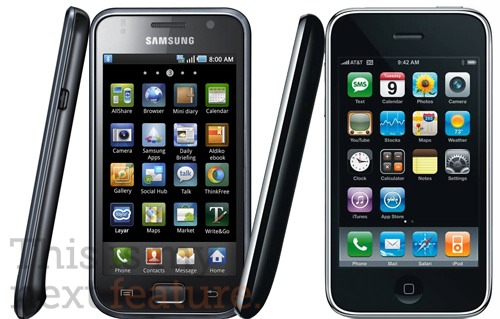
Nilay Patel, in the Verge article linked by Android Community:
Now, some of these are a little ridiculous when taken individually — is Apple going to sue every digital photo frame maker that puts equal size black borders around the screen as well? — but in the end, the main question for the court will be whether or not Samsung has used all of these elements in a way that's likely to confuse consumers about what they're buying.
(Edit: is this wrong? If not, why downvote?)