This article irritates me. Yes there are some emissions involved in mining and manufacturing to produce electric vehicles. No, it does not outweigh the emissions of the vehicle over its lifetime. That’s straight up FUD.
I’d like to point out there’s a lot of emissions in the extraction of oil too. Just look at the tar sands of Alberta where heavy oil is literally dug and steamed from the earth at great environmental cost, and then shipped via diesel trains to the US because a pipeline was politically untenable in the US.
We’re going electric for most vehicles, it will be a good thing once there’s enough momentum behind it, and there’s no other viable option. We cannot keep burning oil. People trying to cling to the ICE are on the wrong side of history.
It's an absolute joke of an article considering it doesn't even float the concept of bicycles or public transport as part of the solution. Then you get to their "solutions" to how we can reduce carbon emissions and find this claim:
> Combustion engines have already been built and are commercially viable that can cut fuel use by 50%.
This is sourced by an article titled "Nissan Says It's Working on an Engine With 50-Percent Thermal Efficiency", whose first paragraph notes that production engines from Toyota already have a 41% thermal efficiency. Turning a hypothetical 9 point increase in thermal efficiency into "can cut fuel use by 50%" is malpractice and you shouldn't trust a single word they say elsewhere.
Thank you. Bicycles and public transport have become the alternatives of which we may not speak. Maybe it's embarassment. Countries like Colombia have made great strides in improving the lives of average citizens by investing heavily in public transportation infrastucture. It's a road we could have gone down, but embraced the primrose path we were led to by car and oil companies. Massively inefficient compared to the alternative of offloading as much traffic as possible in a national electric train system and local subway/cablecar/bicycle commuter highway systems.
I love how articles like this try to make EV's less enticing to justify ICE.
I want clean air in the city.
Less combustion = less air pollution = less cancer.
Less cancer = more years contributing to the economy.
We're in a society. Society is about people. We want to make society better (as Engineers I would like to think so). EV's arguably make society better for people.
> No, it does not outweigh the emissions of the vehicle over its lifetime.
Do you have some data to back this up? It seems very unlikely that you’d save an entire vehicle’s worth of ecological destruction by moving from ICE to power plant.
The real answer is walkways, bike paths, public transportation, trains, remote work and to turn all of our freeways into green spaces.
> It seems very unlikely that you’d save an entire vehicle’s worth of ecological destruction by moving from ICE to power plant.
Why would that seem very unlikely? What is the daily carbon output of a solar panel, wind turbine, hydro electric dam, or nuclear power plant?
> The real answer is walkways, bike paths, public transportation, trains, remote work and to turn all of our freeways into green spaces.
There are entire industries that can’t function without in person work. Talking about turning all freeways into green spaces makes you sound incredibly out of touch with the average American.
The power plants are a lot more efficient, but it does require converting the electric grid over to renewables and nuclear. Natural gas is cleaner, but it’s a stop on the way to the destination, not the destination. We will also achieve that, because quite frankly, we have no choice in the matter.
Walkways, bike paths, and public transit are great things. I wish they did more of that where I live. I’d rather not use cars when I have the option. But they will never be the solution. They should be a part of the solution.
Modern Thermal power plants reached Thermal efficenies of 45-50% for coal and closed cycle gas turbines. ICE cars have a hard time reaching 25% under normal conditions. Additionally burning methane has lower CO2 emissions than gasoline and a third of the US grid is produced from carbon free sources anyway.
The project to replace all cars by EV cars is a fraud. I'm sure not everybody will lose in that project. But don't worry : in the best case (which we know will never be anything but theory and dream), we will resolve 10% of the initial problem. Awesome!
You forgot to include diesel (Gazole), which makes up a whopping 46% of all petroleum use in France.
As for your "scam," it doesn't exist. Nobody's claiming EVs can solve the entire sustainability problem all by themselves. That would be oversimplified, "Silver Bullet" thinking.
EVs are great, but they're just one part of a complete sustainable economy. "Necessary but not sufficient."
I don't understand where you get those number from.
In the first paragraph of your link :
> In 2020, nuclear power made up the largest portion of electricity generation, at around 78%.[2] Renewables accounted for 19.1% of energy consumption.
Engineering Explained went into this in some detail in a video about five years ago[0]. The key takeaway: If two people were driving the same car, and one sold their car and bought an electric car whilst the other kept driving the old car, it would take less than five years (on average) for the electric car to have less emissions than the old, ICE vehicle.
There are certainly some other moral questions here, involving treatment of labour in places where, e.g., we mine for lithium, but those are a bit harder to quantify. The quantifiable aspects are pretty clear, and electric cars are the clear winner.
> It seems very unlikely that you’d save an entire vehicle’s worth of ecological destruction by moving from ICE to power plant.
Even a compact vehicle goes through ~20 tonnes of fuel throughout its lifetime - that's an order of magnitude more than it weighs.
Fuel production in and of itself is an energy-intensive process, with crude being cracked into shorter chains of hydrocarbons at a minimum temperature of 450°C and, depending on the process, pressure of up to 70 atmospheres.
What's more polluting? Producing an appropriate number of solar panels and 350kg worth of battery, or cooking 20 tonnes of crude, which isn't even the whole process?
In Europe university students travel hundereds if not thousands of kilometers to do exchange which can be done by train and many actually do. This is usually the most suitable and most likely time for someone to travel really long distances.
There are also those things called planes which many trains have an express line to.
Even medium speed rail enable people to commute distances like 80 km (50 mi) under 40 minutes, ~30 times each day. There are people who are doing that in my company.
High-speed rail can't stop too often, so all the towns in between stops and far from that line would have to be served by low speed rail, running a few times a day at most.
As everywhere - there's a tradeoff between efficiency and latency. Sometimes it's not worth going all in with efficiency.
Okay, so 20mi of where you were born and the four other places easily accessible by rail. It just wouldn’t work in rural, spread out America.
(Anyway, if we cave to this demand, getting rid of trains will be next on the docket. Remember when the green folks were all about EVs, until they started happening? And now it’s “no personal transportation”?)
You can see some interactive calculations here that show the breakeven (the point at which EV beats ICE on carbon emissions) is around 26,000 km in the UK:
https://www.robinlinacre.com/carbon_electric_car/
There are two big effects:
- the energy usage per mile of electric vehicles is far lower than ICE
- some of the energy used by an electric car can come from renewable sources
Look up Simon Michaux's work on what a full electric transition entails. Yes, we should electrify where possible and massively reduce oil use. But there is no future in which we simply substitute electric vehicles for ICEs and carry on as usual otherwise. Barring some massively transformative technology like cost-effective fusion, we are in for an energy hangover of ominous proportions
Even California's 2035 ICE ban is only for light-duty passenger cars, pickup trucks, and SUVs. As far as I can tell everyone working in the space already understand how much medium/heavy-duty ICE vehicles are contributing to building out green infrastructure and that they are going to be a given for the immediate future.
I don't know much about Simon Michaux but if he is claiming that current regulations are targeting a full electric transition then it seems like he's fighting ghosts.
You’re being downvoted, but you’re correct. Tesla is phasing out both rare earths from their motors and cobalt and nickel from their batteries. Other manufacturers are doing similar.
We don’t use rare earths in batteries. All the big manufacturers are moving from using nickel and cobalt to cheaper materials. There is tons of lithium on earth, that won’t be an issue, especially once we start recycling the batteries as well.
Electric motors often use some rare earths, but manufacturers are also reducing or eliminating those.
We will make the transition. People will not simply curtail their consumption of transportation. The ICE has no future.
I don't want every ICE car replaced with an electric one.
I want liveable, walkable cities, with good bike infrastructure, proper public transport, trees, parks, and public spaces. And fast long distance maglev.
Unfortunately there's already a backlash brewing against "15 minute cities"[1][2]. I wonder how much of this stuff is "organic" and how much is astroturf.
I think that backlash is mostly from the “5g is globalist plot to control us” folks. Although given one of those people is running for the Democratic nomination maybe it’s not as safe to ignore them as I think…
I think that backlash is mostly from the “5g is globalist plot to control us” folks.
I've definitely seen it framed as a "left-wing" plot that the right/Republicans need to fight against. Same thing as the fight against LGBTQ+ rights, abortion rights, etc.
In many cases restrictions and amenities are two sides of the same coin. You often can't add bike infrastructure in cities without taking away something from drivers (travel lanes, parking, etc) because drivers are already given nearly all the space on our streets. Drivers will complain that they're being restricted whenever you take anything away from them.
But people often can't get around safely on bikes without doing so; that bike infrastructure for those who would like to bike is a valuable amenity.
I live in one of the few 15 minute cities and I hate it. You might as well live in a jail or a zoo. Are you envious of the lions that live in their cages? They have everything they need close by! Water, companionship, food, etc....
Can you elaborate on what's so bad about it? I lived in Toronto for a while and rarely had to drive because most things I needed were ~15 minutes away by subway/walking. It was awesome! It's not like someone is going to put an ankle monitor on you to prevent you from going further for stuff if you want to.
Can you elaborate on what you want me to elaborate on? I've been to Toronto, its another "sick town" and nothing I say is going to change your mind if you think living like an ant is "awesome!"
This is all very vague. "Sick town", "living like an ant". Can you actually explain what you mean by any of this?
I'll give you a specific example of why I think Toronto is good. Almost any night of the week I can catch a subway to a music venue - listen to some live music, drink a few beers, socialize a bit. Then I can get home without paying for a taxi or breaking the law by driving intoxicated. What's the equivalent weeknight activity in the suburbs? Sitting on my ass and watching TV all night? How is that less "sick" than what I described? This contrast is especially stark in Canadian winters when the weather and early sunsets make outdoor activities less desirable.
In every conversation I've had on this subject, urbanites discuss the "lack of nightlife" as a problem. My opinions are twofold on this:
A) If you need beer and nightlife to distract you from living in an urban dystopia, there is not much I can do.
B) Most folks that want to leave the cities want space to do things with their families.
1) At night in my semi-suburban setting that I live in now, I work with my kids on things in my garage. Before we had kids, I did the same. My property allows me to spread out and have a woodshop, metalshop, lab, garden etc.
2) In the springtime/summertime tend to my garden (yes at night) so that I can eat natural foods without needing to share an "urban farm". Again, kids are included in this now.
3) Teach/play instruments without the restrictions of an apartment.
4) In the winter sure, if you want nightlife, there isnt much of that.
I don't drink and only listen to gaussian white noise so perhaps I'm not the right person to ask if you're looking for a "nightlife" centered activity/answer.
I truly don't get this perspective. The value of living in a city is proximity to people and amenities. If you value something different, that's totally understandable, but why wouldn't you just move to the country?
Its not like you have to be confined within the 15 min city if you dont want to. You an always take the train or the bus to the 7-11 1 hour away to get your beer. Its just convenient to be in a place where you dont have to drive far away to get your basic amenities. Any East asian city should be a pretty good example.
The strength of cities lies in their density. A well planned city has short commutes. Long distance transport ought to be mostly for goods, not people. If people travel far, travel slow and enjoy the journey. Relying on fast long distance (business) travel is a sign of organizational immaturity at some level.
> Relying on fast long distance (business) travel is a sign of organizational immaturity at some level.
What you say is true, but also a condition that is spectacularly unlikely to change.
Separately, for personal travel, I will sometimes travel low-and-slow, but there are many personal trips where I want to go somewhere for a long-weekend and getting half-way there and turning around doesn't accomplish the goal of the weekend. Even for a week-long vacation, I don't want to spend 4 days getting there and back.
> What you say is true, but also a condition that is spectacularly unlikely to change.
Unfortunately, you're probably right.
Still I don't believe high-speed maglev will solve anything. Less planes, for sure but more people traveling further, more frequently, more efficiently consuming more power in absolutes.
> Even for a week-long vacation, I don't want to spend 4 days getting there and back.
I understand, and feel the same. But I do my best to find a closer destination that's "also" nice, and make sure that when I travel far only when I have proportional amount of time to spend there.
> I do my best to find a closer destination that's "also" nice
When you're trying to escape New England winter weather and get to someplace warm with 11+ hour days (or escape the heat and humidity of Florida in August or visit family), that can be inherently difficult.
Sure, different people in different situations have different standards. Not everyone has the luxury of living in a great city with access to food, energy, jobs and family and friends close by.
Makes you wonder how people in New England winter or Florida summer used to cope a century ago. :-)
I don't want to travel fast and slow from Stockholm to, say, Copenhagen, or to Hamburg when I visit friends or family. I want to get to the destination, fast.
This is what we do, but why? What is it exactly that we hate so much about traveling?
Personally, I hate traffic jams, cancelled trains, flight delays. But I love spending time hiking, cycling, or driving through the empty country at my own pace. More so if I get to spend time with friends and family, for sure.
If the goal of your trip is to hike then fine, hike. But if you’re visiting family that you only see for a few days out of a year you want to maximize that time with them.
If they live far ways, you might consider visiting them only once in two years, spending twice as long. During the pandemic, may people were force to do this and found other ways to stay in touch, like Zoom. (I wouldn't claim that the perfect solution, or good at all. Just something to consider.)
Maglevs are great though when combined with build-in solar. They become energy positive and can replace entire power plants in terms of capacity even on short-ish routes.
Solar roadways are a crappy idea because asphalt and solar panels have completely different engineering requirements, and roads don't even have buildin electrical lines. No contact, no moving part, already electrified and pylonified maglev on the other hand...
People travel for lots of reasons, many of them urgent. You’ll never have everything you need within walking distance, at some point something will be required that is far away whether it’s the birth of a child, a critical piece of equipment, or an expert needed on site. This happens far more frequently than you would think even if it doesn’t happen to you often.
Use train when you can. Trains are getting better and in Europe there is finally talk of prohibiting airlines on short-distance (<500km) flights.
But making trains faster and faster will not improve things as they'll also compete with other forms of transportation (cars, slower trains). If the faster train now gets you 800km in 3 hours, people will travel 800k where previously they spent that time traveling only 500km. It's Parkinson's law.
So does my ant colony analogy apply here? When do we get to move into our hexagonal cell I mean house? You know, bees use hexagons because they are the most efficient use of space.
But please do keep using the "redneck" trope. We're all uneducated hillbillies that obviously aren't as smart and sophisticated as everyone else.
It's true! Some people don't mind or even like climate change—don't they count? What about the flat earthers? We should have a city for them with school districts that cater to their beliefs. Some people abuse animals—where's their city? People should be able to enjoy what they like!
What have you done to ensure your city is "liveable, walkable cities, with good bike infrastructure, proper public transport, trees, parks, and public spaces. And fast long distance maglev."?
How are you moving public policy and private investment towards this goal?
In my limited experience wanting it isn't enough. These types of changes require action.
In which "Western" country do most people live outside cities?
80% of the US population lives in urbanized areas according to the Census bureau. And the density of the census tracts most Americans live in is rising.
And it is possible to have walkable and transit oriented rural areas. Much of the rural US initally sprang up around dense market towns and railroads.
The definition of urbanized areas in the census is not what most of us would say "all of that is city living".
> To qualify as an urban area, the territory identified according to criteria must encompass at least 2,000 housing units or have a population of at least 5,000.
If 100+ million Americans lives in cities, making cities not requiring cars to live in them is a pretty good plus, no? Rural people can keep having their vehicles if they need them, GP didn't say anything against that.
> making cities not requiring cars to live in them is a pretty good plus, no?
Some cities are doing this, but they're not the ones attempting 15-minute cities.
The 15-minute cities are doing things like putting up barricades to make driving more of a pain, without actually making them more livable in those confined locations.
Filtered permeability (which is what I think you're referring to re: barricades) does itself help you live without a car nearby. It cuts down on through traffic for cars in those areas which makes it safer and more comfortable to bike there.
> The 15-minute cities are doing things like putting up barricades to make driving more of a pain, without actually making them more livable in those confined locations.
Examples?
I live in Europe, 15-min cities are quite standard here so I don't really grasp this American issue.
85% and 92% of millenials and Gen Z respectively say they will pay more to live in walkable communities. You can quibble about what constitutes a city but its clear there is a ton of unmet demand for higher density living in the US.
The comparison of 80kg of gas in a tank to a 1000kg battery is disingenuous as the gas is turned over frequently, it’s a reasonable rule of thumb (at the Fermi problem level) that a car uses about it’s own weight in gas in a year.
Conservatives (like the old man I met a the gas station last week) hear a lot about the problem of battery recycling. It is a real problem, but it's got answers.
I was amused to see that the methods planned for extracting critical elements from batteries are essentially the same methods used to process used nuclear fuel. That is, you can use hydroprocessing where you dissolve the batteries in acid and use acid-base extractions to separate out the components or you can use pyroprocessing where you use melt them down and use molten salts, electrolysis, reducing gases, stuff like that.
It's clear that batteries contain critical elements in a higher concentration than ores, and you don't have the special problems of plastic recycling. (e.g. any handling of the plastic spreads microplastics, simply melting and recasting the plastic produces an inferior product, chemical recycling back to the monomer is possible in principle but still not commercialized, even in the easy case of styrene, and chemical recycling by pyrolysis to "petrochemicals" is dirty)
“In another example of illusory precision, the Wall Street Journal—in a 2021 investigation seeking to unearth the truth about EV emissions”
The Wall Street Journal is biased garbage when it comes to climate change.
They’ve spent decades doing everything they can to provide their climate change denying audience with plenty of noise to slow any transition to a greener economy.
Thousands of words and climate change is mentioned 7 times, often in quotes, usually disparagingly. Meanwhile, I am pulling an all-nighter in my workshop as I write this, building hardware to overcome the challenges this guy is grumping about.
Climate change is not a war of words anymore. Either put your shoulder to the wheel or get out of the way.
So happy to see so much sane critical thinking in the comments here.
What I’d like to add is that the article lacks any reflection over the long term perspective. Mining/transportion/refining of materials could be completely carbon neutral. What’s missing for that to happen? Electrification. We’ve already seen some mining equipment move to electrification. What’s helping drive this? EV and battery technologies.
We’ve also seen great strides in battery recycling. I have no doubt that lithium batteries will be part of a near 100% circular economy in the future. Similar to what’s already the case with lead acid batteries. Apple seems to have made serious commitments in this area and it’s significantly harder to make it economical for their use case than for EV batteries. By some accounts it seems like it’s already economical to reuse and recycle EV batteries.
In this regard the skepticism in the article is deeply flawed: the materials mined for EV batteries will most likely provide economical value and offset CO2 emissions for decades after the life of the vehicle. In the best case the EV battery pack can be directly repurposed for grid energy storage after the life of the vehicle.
> We’ve also seen great strides in battery recycling. I have no doubt that lithium batteries will be part of a near 100% circular economy in the future.
Even if it takes a while to get good battery recycling it won't be a problem.
Imagine every single person on Earth had an EV, and that they used them so much that the batteries had to be replaced every 5 years, and that we have no battery recycling so all those old batteries just get dumped in a landfill to await some future recycling advances.
So we start building huge battery landfills in deserts and other uninhabited places, say 20 miles x 20 miles by 50 feet deep.
If it took 200 years of this before we figured out how to recycle the batteries we'd have only needed to build ~70 of those landfills.
"In this regard the skepticism in the article is deeply flawed: the materials mined for EV batteries will most likely provide economical value and offset CO2 emissions for decades after the life of the vehicle."
The article addresses this exact issue in the executive summary and then later on in detail.
"No one knows how much, if at all, CO2 emissions will decline as EV use rises. Every claim for EVs reducing emissions is a rough estimate or an outright guess based on averages, approximations, or aspirations."
I'm less concerned with the production emissions of EVs and more concerned with how awful repairability is for EVs on the market right now. EVs are relatively simple compared to their ICE counterparts, so it should be easier to repair them. But instead I keep hearing horror stories about battery designs that require you to replace the whole pack when a few cells die. And since EVs are usually treated as "luxury" vehicles right now, they also often come with silly features that add very little functionality and mostly serve as additional points of failure.
Fragile features and poor rapairability - especially for parts that are expected to wear out like batteries - reduces a vehicle's lifespan, meaning we have to produce more vehicles to keep up with demand. Production emissions are much less concerning to me if the vehicle is expected to last 30+ years.
My LEAF had an individual battery module replaced (under warranty) and I’ve heard anecdotes of several other EV owners online with a similar repair story. They’re not “all or nothing” already, though some probably are.
By way of acknowledging the tradeoff, though, I think the Leaf battery is significantly easier to perform a module replacement on by virtue of it having such primitive (and less effective) thermal management. It's (poorly) air-cooled and thus degrades the battery modules more quickly than nearly any other EV on the market.
> Production emissions are much less concerning to me if the vehicle is expected to last 30+ years.
Rust due to environmentals and road salt usage precludes most New England cars lasting 30+ years now. Our 2005 Honda CR-V is a great car, still very good mechanically (at 229K miles), but will be retired within the next 5-10 years due to rust.
I live in the midwest, so I'm definitely familiar with rust. But the rust doesn't usually harm much more than aesthetics for the first few decades. If your 2005 CR-V makes it just 11 more years, it'll join that 30+ club. As long as she still runs, you can probably find a high school kid who will take it off your hands for around the scrap yard price.
It's nice to hear some confirmation that the battery replacement issue isn't ubiquitous. Modular batteries definitely make more sense. If manufacturers can divide up the batteries into enough modules and adhere to some kind of open standard for how those modules interface with the pack, that would go a long way towards making EV ownership economical and increasing their longevity.
The rust-as-just-aesthetics ship sailed long ago. We're at the "water intrusion into the cabin" and "lower rockers are starting to show mechanical degradation" stage. It's 50/50 to pass safety inspection five years from now.
This is an actual risk, probably worse is the repairability from accidents documented by the New York Times.
"The damage was initially deemed relatively minor, and the other driver’s insurer offered him $1,600. The actual cost to fix the bumper at a business certified to repair Rivian vehicles — one of just three in Ohio — was $42,000, roughly half the truck’s selling price."
There are emissions in refinement, production, and charging.
But if a vehicle runs on a battery, those lifecycle emissions can be improved as we did with the fleet itself. It decouples the car’s energy source from what the manufacturing process produces.
In the case of a gas car, the whole production chain revolves around the extraction and burning of oil and gas. There’s no escaping any of it.
FUD ("No one knows...", "uncertainties" etc.), sprinkled with lies ("The arrival of useful EVs didn’t happen because of government mandates or incentives.", "In contrast to cars with internal combustion engines, it’s impossible to measure an EV’s CO2 emissions.").
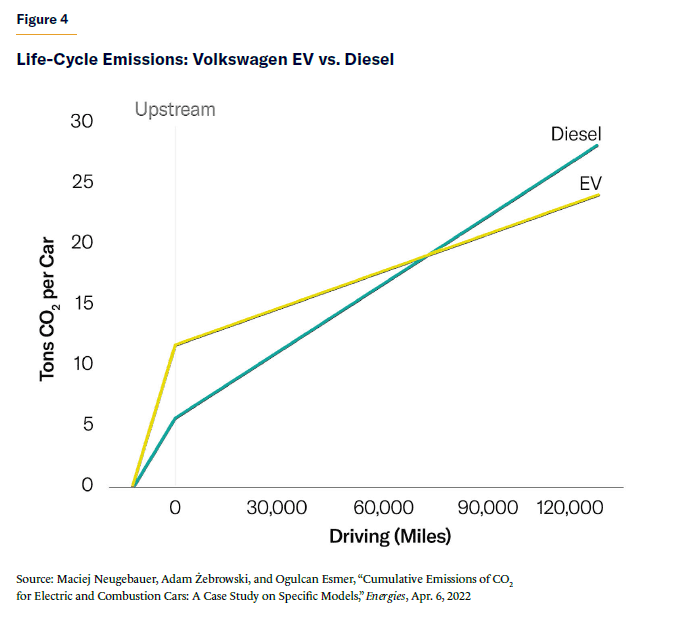
I checked the source of the figure titled "Life-Cycle Emissions: Volkswagen EV vs. Diesel".
I may be missing something but the figure does not match any figure in the source. I feel like the maths are probably right, but the source doesn’t include the production of the ICE car and one axis is the years and not the mileage.
> The purpose of this analysis was to determine whether the replacement of an existing combustion car (that has already been manufactured; therefore, this part of the analysis does not include CO2 emissions in the production stage) with a new electric car, which has to be manufactured, therefore associated with additional CO2 emissions, would reduce cumulative CO2 emissions.
I think it’s fair to change a figure and add additional data, but maybe don’t cite it as coming from a trusted source.
Just so we’re clear, by conventionally powered vehicles we’re talking about petrol/diesel, which even setting aside any greenhouse effects, and completely ignoring the massive negative health externalities of pollution, is at the very least a ridiculously expensive supply chain spanning the globe that requires a massive naval machinery to even exist, has driven and caused multiple wars, props up the most awful dictatorships, and is entirely responsible for funding global terror networks.
It’s a system which causes massive inflation to the point of having sunk several countries (Sri Lanka, Pakistan) over the last few years itself for reasons completely out of their control.
If not 1 mg of carbon emissions was reduced by switching over to EVs, and not one life was saved or lengthened thanks to reducing the toxic pollution anyone living in a city is forced to breathe thanks to ICE cars, the switch to EVs with the subsequent the elimination of the dependence on this global war and terror machine would in itself be a massive win.
Of course, contrary to what this article suggests we do have fairly good ideas as to the impact of switching to EVs on emissions, etc. We can’t mail it down exactly, but we know what the ranges look like. And even the least optimistic side of those ranges make EVs a better option than ICE vehicles.
"Of course, contrary to what this article suggests we do have fairly good ideas as to the impact of switching to EVs on emissions, etc. We can’t mail it down exactly, but we know what the ranges look like. And even the least optimistic side of those ranges make EVs a better option than ICE vehicles. "
You just restated the case the report made with a different spin. The spin it is arguing against. The spin it states many facts against saying it is fundamentally flawed.
I will be very happy when the vast majority of consumer vehicles are electric. The amount of extra heat generated by people sitting in their running cars with the AC running is incredible. I get it - this can’t be helped while at a stop sign or red light, but the sheer number of people who just park their car waiting to get their groceries (while on their phone), having lunch, sleeping, etc with the car running is absolutely ridiculous. So much extra heat needlessly generated.
Catalytic converters contain much less common materials than anything in the battery or motor of EVs. This idea EVs are harder to make than ICE cars is nothing but FUD.
I think you're getting downvoted because the quantities of rare earth metal required for these two things are vastly different. Some quick googling shows that a catalytic converter for a car contains 1-2g of platinum, while an EV uses 8kg of cobalt. So while platinum is more rare, you only need a tiny amount for each vehicle.
Cobalt is not a rare-earth though. Neither is platinum. Also LFP batteries - something e.g. China went all in on require no cobalt whatsoever.
NiMH batteries in old hybrids used Lanthanum and BLDC motors use Neodymium, but the former was never used in mass-produced EVs and the latter can be supplanted by either AC induction motors (like in early Teslas) or, more recently, switched reluctance motors.
Totally agree that it is just something being thrown around to little benefit. That said don't compare catalytic converter materials to what they are talking about in EVs. The quantities needed are orders of magnitude different. The easier thing to talk about that gets glossed over is all of the energy expended to extract fossil fuels in the first place.
> But in banning ICE cars and mandating the use of EVs, policymakers are explicitly betting on the truth of three crucial claims:
> EVs will lead to “profound” reductions in CO2 emissions
Seems so, okay.
> EVs are now, or will soon be, cheaper than, and operationally equal to, ICE cars
No, why? The governance bodies can ban fossil fuel vehicles and let the people figure out what they want to replace it with, if anything. This is not a required assumption (maybe required if you want to get re-elected, but I'm not even sure of that).
> There is a diminishing role for the automobile in modern times; in effect, there is a generational realignment in how citizens seek personal mobility.
How about "the regulation will diminish the role of the automobile"? The law doesn't have to be reactive. It can drive change, too, and a lot of people want that change.
"Census data, however, show that the urbanization trend ended around 2010, when net migration to nonmetro and rural areas began.[21] While that trend was briefly accelerated by the lockdowns, the net migration to rural and ex-urban zip codes reverted to the trend “observed prior to the pandemic.”[22] As one researcher noted in 2022, the de-urbanization trend could “become more commonplace” if late millennials and Gen Zs follow evidence suggesting that a rising share find “suburban and small-town life more attractive”"
Is that a family car? How does it compare to the minivan, CUV or SUV most families currently drive? What does a family have to move up to? Is that economical to the average family on a budget?
The price of EVs is coming down but at the same time they are adding more range and other features which are pushing the prices up. In about 5 years EVS will become less expensive than ICEVs.
The prices are coming down but at the same time they are increasing the range and other features which are keeping the prices from falling as fast. In 5 years, EVs will be less expensive than ICEVs. ICEVs have had over 100 years to be optimized and cost reduced. EVs have had less than 15 years so far. They will keep getting less expensive for a long time yet.
Well the only cost reduction driver now is increase in volumes. As PHEVs will die out, we will see about 10x increase in volumes vs 2022, in maybe 20 years (to fill in ~90% of today's or ~75% of that time's global demand, assuming demand grows 20%). Normally for every high tech product, a 10x increase in volumes results in about 2x reduction of price, give or take - we are about to see whether it comes true.
Amazing that the right-wing institute here is pushing higher fuel efficiency standards in place of EV mandates after decades of the American right gutting fuel efficiency standards.
"advancing opportunity, individual liberty, and the rule of law" - I wish I could trust statements like this and not just read them as code for "right wing conservatives determined to stand athwart history yelling stop".
It makes me absolutely crazy that US ICE fuel efficiency standards remained as low as they were for so long with the bonkers carveout for SUVs and light duty trucks. The Prius hybrid and similar cars have some of the lowest total cost of ownership of any vehicle; a little nudge from the feds would have had similar powertrains in every car for the last decade, which would have made a real dent in emissions.
Of course now it's too late for that, and going full EV at the same time as reducing power grid emissions is the only path left. And at that, the article is likely right, it's going to be fantastically expensive and cause lots of other problems. The solution, unlike the article posits, is alternatives to large, heavy, individual powered vehicles.
No one even talks about the alternate reality - the earth is already getting too warm for humans to live and they're literally dying from the heat. Oh sure, it's "only" the most vulnerable people, the really old and the really young, but it's coming for more and more of the population as temperatures continue to soar.
Responsible people recognize there is a problem and work to resolve it. Irresponsible people simply bury their head in the sand.
One of the silver linings of the whole climate change debacle, is the libertarian right utterly immolating their already flimsy credibility, and with every appearance of being determined to go down with the ship.
People always mention the rare earth minerals used in EV's, while completely ignoring the rare earth minerals in a catalytic converter. I went to my new favorite AI tool, Google's Bard, to get an answer. I asked "how much rare earth materials are used in a catalytic converter versus an EV" and this is the answer:
I don't know if it's right, Bard isn't 100% correct, but it is interesting and jives with what I know about catalytic converters and EV manufacturing. The TL;DR is anyone expressing concern about "rare earth minerals" with regards to EV's are simply spreading FUD.


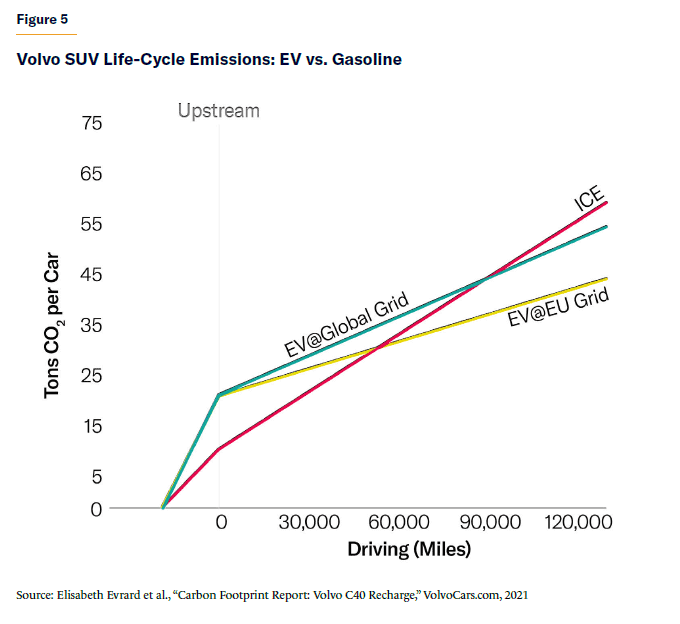
I’d like to point out there’s a lot of emissions in the extraction of oil too. Just look at the tar sands of Alberta where heavy oil is literally dug and steamed from the earth at great environmental cost, and then shipped via diesel trains to the US because a pipeline was politically untenable in the US.
We’re going electric for most vehicles, it will be a good thing once there’s enough momentum behind it, and there’s no other viable option. We cannot keep burning oil. People trying to cling to the ICE are on the wrong side of history.