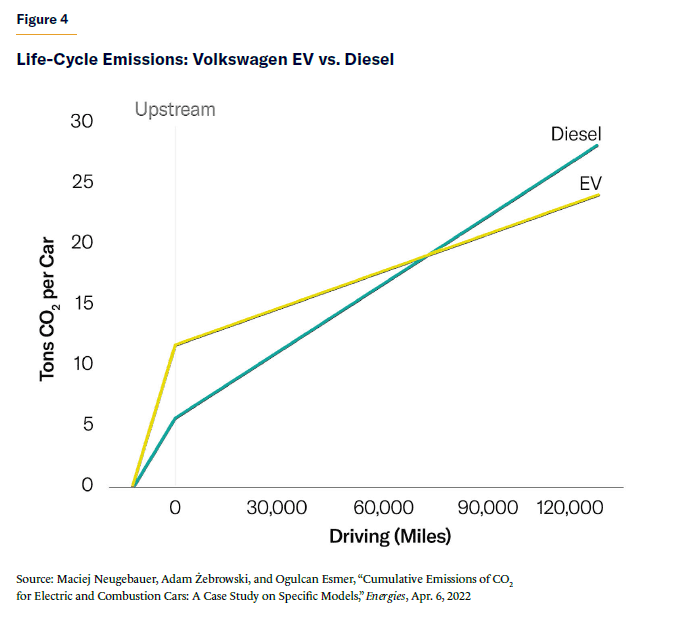
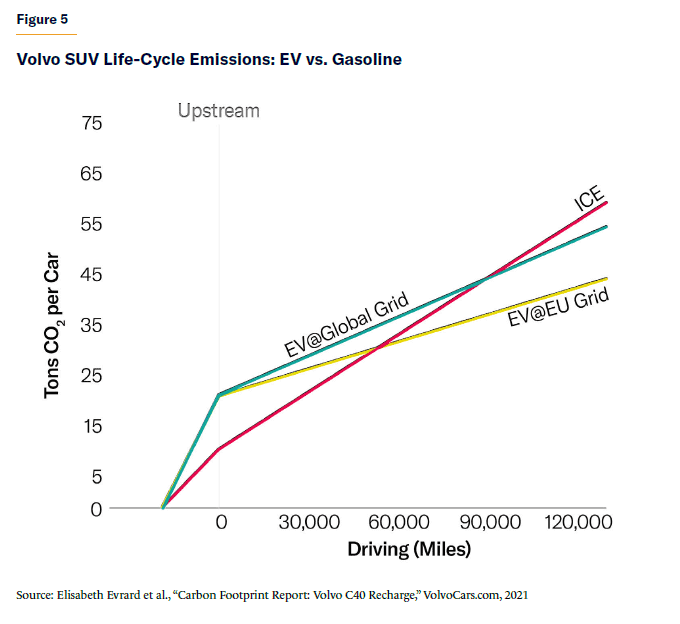
This article irritates me. Yes there are some emissions involved in mining and manufacturing to produce electric vehicles. No, it does not outweigh the emissions of the vehicle over its lifetime. That’s straight up FUD.
I’d like to point out there’s a lot of emissions in the extraction of oil too. Just look at the tar sands of Alberta where heavy oil is literally dug and steamed from the earth at great environmental cost, and then shipped via diesel trains to the US because a pipeline was politically untenable in the US.
We’re going electric for most vehicles, it will be a good thing once there’s enough momentum behind it, and there’s no other viable option. We cannot keep burning oil. People trying to cling to the ICE are on the wrong side of history.
It's an absolute joke of an article considering it doesn't even float the concept of bicycles or public transport as part of the solution. Then you get to their "solutions" to how we can reduce carbon emissions and find this claim:
> Combustion engines have already been built and are commercially viable that can cut fuel use by 50%.
This is sourced by an article titled "Nissan Says It's Working on an Engine With 50-Percent Thermal Efficiency", whose first paragraph notes that production engines from Toyota already have a 41% thermal efficiency. Turning a hypothetical 9 point increase in thermal efficiency into "can cut fuel use by 50%" is malpractice and you shouldn't trust a single word they say elsewhere.
Thank you. Bicycles and public transport have become the alternatives of which we may not speak. Maybe it's embarassment. Countries like Colombia have made great strides in improving the lives of average citizens by investing heavily in public transportation infrastucture. It's a road we could have gone down, but embraced the primrose path we were led to by car and oil companies. Massively inefficient compared to the alternative of offloading as much traffic as possible in a national electric train system and local subway/cablecar/bicycle commuter highway systems.
I love how articles like this try to make EV's less enticing to justify ICE.
I want clean air in the city.
Less combustion = less air pollution = less cancer.
Less cancer = more years contributing to the economy.
We're in a society. Society is about people. We want to make society better (as Engineers I would like to think so). EV's arguably make society better for people.
> No, it does not outweigh the emissions of the vehicle over its lifetime.
Do you have some data to back this up? It seems very unlikely that you’d save an entire vehicle’s worth of ecological destruction by moving from ICE to power plant.
The real answer is walkways, bike paths, public transportation, trains, remote work and to turn all of our freeways into green spaces.
> It seems very unlikely that you’d save an entire vehicle’s worth of ecological destruction by moving from ICE to power plant.
Why would that seem very unlikely? What is the daily carbon output of a solar panel, wind turbine, hydro electric dam, or nuclear power plant?
> The real answer is walkways, bike paths, public transportation, trains, remote work and to turn all of our freeways into green spaces.
There are entire industries that can’t function without in person work. Talking about turning all freeways into green spaces makes you sound incredibly out of touch with the average American.
The power plants are a lot more efficient, but it does require converting the electric grid over to renewables and nuclear. Natural gas is cleaner, but it’s a stop on the way to the destination, not the destination. We will also achieve that, because quite frankly, we have no choice in the matter.
Walkways, bike paths, and public transit are great things. I wish they did more of that where I live. I’d rather not use cars when I have the option. But they will never be the solution. They should be a part of the solution.
Modern Thermal power plants reached Thermal efficenies of 45-50% for coal and closed cycle gas turbines. ICE cars have a hard time reaching 25% under normal conditions. Additionally burning methane has lower CO2 emissions than gasoline and a third of the US grid is produced from carbon free sources anyway.
The project to replace all cars by EV cars is a fraud. I'm sure not everybody will lose in that project. But don't worry : in the best case (which we know will never be anything but theory and dream), we will resolve 10% of the initial problem. Awesome!
You forgot to include diesel (Gazole), which makes up a whopping 46% of all petroleum use in France.
As for your "scam," it doesn't exist. Nobody's claiming EVs can solve the entire sustainability problem all by themselves. That would be oversimplified, "Silver Bullet" thinking.
EVs are great, but they're just one part of a complete sustainable economy. "Necessary but not sufficient."
I don't understand where you get those number from.
In the first paragraph of your link :
> In 2020, nuclear power made up the largest portion of electricity generation, at around 78%.[2] Renewables accounted for 19.1% of energy consumption.
Engineering Explained went into this in some detail in a video about five years ago[0]. The key takeaway: If two people were driving the same car, and one sold their car and bought an electric car whilst the other kept driving the old car, it would take less than five years (on average) for the electric car to have less emissions than the old, ICE vehicle.
There are certainly some other moral questions here, involving treatment of labour in places where, e.g., we mine for lithium, but those are a bit harder to quantify. The quantifiable aspects are pretty clear, and electric cars are the clear winner.
> It seems very unlikely that you’d save an entire vehicle’s worth of ecological destruction by moving from ICE to power plant.
Even a compact vehicle goes through ~20 tonnes of fuel throughout its lifetime - that's an order of magnitude more than it weighs.
Fuel production in and of itself is an energy-intensive process, with crude being cracked into shorter chains of hydrocarbons at a minimum temperature of 450°C and, depending on the process, pressure of up to 70 atmospheres.
What's more polluting? Producing an appropriate number of solar panels and 350kg worth of battery, or cooking 20 tonnes of crude, which isn't even the whole process?
In Europe university students travel hundereds if not thousands of kilometers to do exchange which can be done by train and many actually do. This is usually the most suitable and most likely time for someone to travel really long distances.
There are also those things called planes which many trains have an express line to.
Even medium speed rail enable people to commute distances like 80 km (50 mi) under 40 minutes, ~30 times each day. There are people who are doing that in my company.
High-speed rail can't stop too often, so all the towns in between stops and far from that line would have to be served by low speed rail, running a few times a day at most.
As everywhere - there's a tradeoff between efficiency and latency. Sometimes it's not worth going all in with efficiency.
Okay, so 20mi of where you were born and the four other places easily accessible by rail. It just wouldn’t work in rural, spread out America.
(Anyway, if we cave to this demand, getting rid of trains will be next on the docket. Remember when the green folks were all about EVs, until they started happening? And now it’s “no personal transportation”?)
You can see some interactive calculations here that show the breakeven (the point at which EV beats ICE on carbon emissions) is around 26,000 km in the UK:
https://www.robinlinacre.com/carbon_electric_car/
There are two big effects:
- the energy usage per mile of electric vehicles is far lower than ICE
- some of the energy used by an electric car can come from renewable sources
Look up Simon Michaux's work on what a full electric transition entails. Yes, we should electrify where possible and massively reduce oil use. But there is no future in which we simply substitute electric vehicles for ICEs and carry on as usual otherwise. Barring some massively transformative technology like cost-effective fusion, we are in for an energy hangover of ominous proportions
Even California's 2035 ICE ban is only for light-duty passenger cars, pickup trucks, and SUVs. As far as I can tell everyone working in the space already understand how much medium/heavy-duty ICE vehicles are contributing to building out green infrastructure and that they are going to be a given for the immediate future.
I don't know much about Simon Michaux but if he is claiming that current regulations are targeting a full electric transition then it seems like he's fighting ghosts.
You’re being downvoted, but you’re correct. Tesla is phasing out both rare earths from their motors and cobalt and nickel from their batteries. Other manufacturers are doing similar.
We don’t use rare earths in batteries. All the big manufacturers are moving from using nickel and cobalt to cheaper materials. There is tons of lithium on earth, that won’t be an issue, especially once we start recycling the batteries as well.
Electric motors often use some rare earths, but manufacturers are also reducing or eliminating those.
We will make the transition. People will not simply curtail their consumption of transportation. The ICE has no future.


I’d like to point out there’s a lot of emissions in the extraction of oil too. Just look at the tar sands of Alberta where heavy oil is literally dug and steamed from the earth at great environmental cost, and then shipped via diesel trains to the US because a pipeline was politically untenable in the US.
We’re going electric for most vehicles, it will be a good thing once there’s enough momentum behind it, and there’s no other viable option. We cannot keep burning oil. People trying to cling to the ICE are on the wrong side of history.